
How do we translate the cause of open borders into specific policy recommendations? The range of policies entailed by “looser border controls” is wide — and the range of policies which might be mistakenly attached to the “open borders” idea is even wider. It is important to be clear on definitions when we discuss the idea of open borders, lest we waste time on proposals which few actually support.
Before I continue, note that I speak only for myself; not for Vipul, not for Nathan, and not for any other advocate of open borders, even though we all support greater immigration. In fact, immigration supporter Tyler Cowen declares himself opposed to open borders, even though I suspect under my definition of “open borders”, he may be one of our greatest advocates.
It is crucial to be clear about what “open borders” really means in terms of end goals. Being vague about the meaning of “open borders” makes it easy for restrictionists to attack straw men, while ignoring the strongest arguments for open borders. So when I seek open borders, here is what I want: people to be able to cross international borders at will, insofar as this is administratively practical.
Before moving on, here are some things which I do not want (or if I do want them, not as part of the “open borders” cause) — but which restrictionists or skeptics have sometimes attacked:
- Immediate transplantation of hundreds of millions of people from poor countries to rich countries
- Government subsidisation of immigration
- Abolition of national sovereignty or international borders
- Equal political rights for immigrants
- Redistribution of wealth across borders, or from citizens of rich countries to citizens of poor countries
I do not think we need much positive action to make open borders a reality; all governments need to do is, quite literally, get out of the way. When someone asks me what I would do about 300 million poor people if they suddenly showed up in California tomorrow morning, I think, “How on earth would they ever do that without massive government aid? And why would opening the borders entail government subsidies for immigration?”
All I want is, again, people to be able to cross international borders at will, insofar as this is administratively practical. I recognise that the second clause appears wishy-washy; we can certainly debate what it means. But if tomorrow everyone agreed with that statement — even if we disagreed about how to define “administratively practical” — the ranks of restrictionists would thin by the hundreds of millions.
I focus on administrative practicality because simply conditioning fully open borders on “as is practical” leaves open the immense question of who decides what is practical, and how. Tyler Cowen says he opposes open borders because even without border controls, land use restrictions will keep many immigrants out. Tyler defines “open borders” as not only looser border controls, but also looser land use regulations; in short, he has defined it as “abolishing all government restrictions that might impact freedom of movement, directly or indirectly”. But Tyler is focused on whether immigration is “practical” — not whether it is administratively practical.
I think prospective immigrants are the best judge of whether moving to a new place is “practical”; I see no reason for others to judge whether it makes sense for a Londoner to move to Moscow, any more than they would judge whether he should move to Glasgow. That Londoner may in the future create problems for the community of Moscow. The authorities over Moscow can handle him as they wish, the same way those with authority in Glasgow can handle him if he moves there. Governments may take care of troublemakers as they wish. What I deny is the moral right of governments to refuse entry to someone based purely on the possibility that he might be a troublemaker in the future — especially when they do not do the same to their own citizens.
Governments do have the right to refuse entry to people; they do and should have control over their own borders. But there exists a strong moral presumption that every person has a right to entry. The right to entry should only be refused if there is evidence to override that presumption. For instance, if someone is actively being sought by INTERPOL for a crime, that near-certainly should override the presumed right to entry.
Crossing borders tends to have administrative implications: you, the border-crosser, may be a criminal. You may be looking for welfare from the state. If states wish to enact border controls to keep out obvious criminals or obvious burdens on the state, that is fine by me. What is not fine is presuming that every prospective border-crosser is a criminal or social parasite, and forcing every border-crosser to prove otherwise.
Since laws and welfare systems can vary immensely by country, administrative necessity will tend to dictate some border controls for most countries, and this likely will remain so for some time. But once one concedes that only administrative necessity can justify border controls, a few specifics come into focus:
- There should be no arbitrary cap on the visas a state grants
- Any cap must be justified based on a concrete reason; the moral presumption is that immigration should be uncapped
- Visas should be granted freely unless there is evidence to rebut the presumption of innocence
- Just as permits for public gatherings and other such licences are, in the vast majority of cases, granted as of right
- Visa restrictions on length of stay or activities within a state (such as studying or employment) must be justified by an explicit reason
- For instance, under EU law Spain had to explicitly justify restrictions on work permits for Romanians
- Border controls between more countries should be abolished or minimised
- If the Schengen zone can do it, so can most OECD countries
- Such a zone already exists to some degree in North America (most Malaysians need a visa to enter Canada or Mexico, but since I have a green card, I can enter either country without a visa — though I cannot stay for long)
- Some non-Schengen zone countries like the UK already implement an expedited border control process for European citizens, and grant them the right of residence — why can’t more developed countries do the same?
We allow governments to do many things in the name of keeping the peace and preserving public order. A citizen’s freedom of movement can be hampered by the yellow line marking a police investigation; by a curfew; by permanent banishment from a city for previous public indecency (an actual example that has happened to a friend-of-a-friend). But we generally do not allow governments to limit their own nationals’ freedoms based on the presumption that all blacks are drug dealers, all Italians are mobsters, or all Muslims are terrorists. If we think these are bad ideas, how is it a better idea to presume that all people who weren’t lucky enough to be born as citizens of your country are bad people?
One reason I used to take open borders less seriously is because I thought it was obviously impractical to abolish border controls between all countries, let alone abolish national borders and sovereignty — even though I can see the cases for both. What I did not think about then was how arbitrarily restrictive the status quo is, one that punishes millions of people for literally no good reason. The arbitrariness of the status quo actually makes it one of the more impractical outcomes imaginable.
I recognise that many open borders advocates won’t share my exact views here, and would love to hear others’ thoughts. But regardless of what we ultimately desire, we (even those who may not go as far in supporting open borders) all share the goal of reducing the arbitrary barriers to immigration that proliferate today. The status quo is morally and economically unjustifiable, and virtually any move towards more liberal immigration policies anywhere is one that all human beings should welcome.
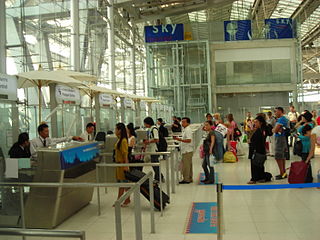
The photograph of passport control at the Suvarnabhumi International Airport in Bangkok, Thailand featured at the top of this post was found on Wikimedia Commons, and is available in the public domain.


John Lee is an administrator of the Open Borders website. Liberal immigration laws are a personal passion for him. See all blog posts by John.

I think this is reasonably in line with what I want as well. There are probably disagreements at the margin. But I think that the key thing for open borders advocates to understand is that we shouldn’t let disagreements at the margin bog us down considering that we are all pretty unanimous about the direction in which change needs to happen relative to the current status quo.
I’ll probably blog this later in more detail: I notice that a lot of commenters on Caplan’s recent persuasion bleg indicated that they’re substantially convinced, but have reservations about some minor aspect. I’d say that this is a concern that can serve to divide once the ball is rolling in moving toward more open borders. It’s not something that should justify complete inaction in terms of trying to change the status quo. But some of Caplan’s commenters seem to be making the case that until Caplan convinces them 100%, they’ll stick with the status quo.
I personally do have concerns about some of the effects of open borders. I just don’t see them as significant enough to make a case against open borders, but I can understand if some people push for keyhole solutions because they are more worried about these than I am. It’s the attitude of “sorry, you didn’t convince me 100%, so I’ll stick with the arbitrary and terrible status quo” that I don’t have a lot of admiration for.
Reply
My answer to “What do open borders advocates really want?” would start with: No deportation. To seize by force a person who is peacefully minding his own business, or interacting with others on a consensual basis, on public land (see my theory of streets) or private land he owns or with the consent of another private owner, and take him to another country against his will, is pretty much always and everywhere wrong. It’s most criminal when the people being deported have grown up in a place and have no other home, as with DREAMers, or when it results in the separation of families. But I don’t think deportation is justifiable under virtually any circumstances, apart from extraditing criminals. If deportation is impermissible, how do you make immigration restrictions incentive-compatible? You probably can’t. At any rate, you can’t do it without violating a lot of rights.
I found myself resisting a bit when you write: “Governments do have the right to refuse entry to people; they do and should have control over their own borders.” Where does that right come from? Where do borders come from, and what is their moral significance? I agree with you that open borders does not mean the abolition of nation-states or international borders. In fact, during the 19th-century age of open borders, the nation-state model was thriving. You might even say it was at the peak of its influence. So nation-states and open borders are consistent. It’s not just a historical example that proves this. We can see it by reason. Suppose a nation-state says: “This government is the elected represented of a certain body of citizens. It claims certain powers, exercised on their behalf. It has the duty to protect their lives, liberty and property, and exercises power in the fulfillment of this duty. It seeks to establish a monopoly of force within a certain territory. It will fight against any other agencies exercising force within this territory, whether it be organized crime or an invading army. It will use force, if necessary, to protect its citizens as long as they are within this territory, but typically not when they are outside it. It will often use force to protect the rights of non-citizens within this territory as well. Such are its powers. To exclude peaceful non-citizens from the territory is not among the rights it claims or the powers it exercises. No efforts will be made to prevent peaceful entry by any person.” What is there illogical, inconsistent, or infeasible about this? This is a policy, one might even say a constitution, of open borders. It is not abolition either of international borders or of the nation-state. Nation-states and international borders are still there. They define legal jurisdiction. But they don’t regulate the movement of people. I’m not saying we should establish it tomorrow, but it’s the goal.
I also resisted this: “If states wish to enact border controls to keep out… obvious burdens on the state, that is fine by me.” Why keep them out? Why not say, “You can come, if you like, but you’re not eligible for any welfare. You’re on your own. If you still want to come, welcome.”
Reply
Nathan,
Thanks for your thoughts. I completely agree with everything you’ve said about deportation (I don’t personally know any victims of deportation, but I know plenty of people who have “self-deported”, starting with my own mother from Malaysia), and overall I think we are probably 95%, maybe even 100%, in agreement.
Re actual literal open borders, I think this is a desirable end state for me as well. What I envision is the actual “administrative necessities” that stand in the way of open borders diminishing over time. What I’ve outlined in my post is what I think is completely feasible in the here and now, or the very near future.
The main reason I think 19th-century-style open borders are not currently feasible is that while the 19th century might have been nationalism’s heyday, it wasn’t the state’s heyday. I think we are now living in the heyday of the state. The reach of legal and social welfare systems today is far more extensive than it ever was in the most developed societies of the 19th century. For this reason, I can see the argument that literal open borders would undermine the “state” aspect of the nation-state.
My main thinking around “burdens on the state” was that most modern countries subsidise things like healthcare to large degrees for the destitute, and quite often with little regard for things like immigration status. (The idea being that a state still has some basic obligations to non-citizens who reside in its jurisdiction — can’t very well let a Somalian starve to death on your doorstep, though if he’s outside your jurisdiction, somehow that’s much less bothersome.)
I think the presumption ought to be to let everyone in, but if someone walks up to an officer of the state and says point-blank, “I want to come to your country because I want to use your welfare system,” I can see an argument for rebutting that presumption. Immediately opening the borders 1800s-style would entail the opening of immense political debates and large revisions to vast swaths of public policy that seem quite administratively burdensome to me, even if I think that the decision to refuse entry here remains morally questionable.
I come back to administrative necessity as the only justifiable reason I can see for allowing any border controls to exist at all: given the way modern states function, I can see the argument that states need to know the identity of people entering their borders, and be able to verify that they don’t obviously pose a threat to their public (e.g. no outstanding arrest warrants, properly vaccinated, etc.).
I am nevertheless optimistic that technology and globalisation will soon reduce the administrative necessities that circumscribe the possibilities of open borders. And until then, I think we can push for significant liberalisation of the immigration status quo without getting bogged down in having to rewrite welfare laws or land use laws, as desirable as those causes might be too in broadening freedom of movement.
Reply