
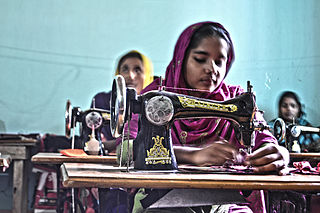
Substandard working conditions recently murdered over 1,000 people in the deadliest garment factory accident in history. This accident in Bangladesh drew attention to the substandard wages of “sweatshop” workers in the developing world, and industrialists’ scant regard for their workers’ safety. Many on the left in the developed world saw this as an indictment of free market economics, urging government action to prevent such future disasters. Responding to such pressures, the US government recently raised tariffs on a number of Bangladeshi goods. I’m as concerned as anyone that Bangladeshi workers aren’t earning a fair wage or working in dangerous conditions. So it strikes me as strange that utterly absent from this debate has been the one measure that we know for sure would alleviate these conditions for countless Bangladeshis.
If we truly find it disgusting that Bangladeshis aren’t earning a fair wage for their work, or are being forced to work under slave-like conditions, we should ask ourselves: who is trapping Bangladeshis in their antiquated, inefficient economy? Do Bangladeshis really want to risk death every day to earn a pittance?
The standard analysis of this problem points out that the alternative to most Bangladeshis employed in industry is a life of subsistence agriculture. Farmers run the perennial risk of crop failure, and in the developing world, most subsistence farmers literally live hand to mouth, doing backbreaking labour in the sun. Industrial work may be risky, but it’s often a better alternative.
In response, you can argue that if people have to choose between a life of subsistence agriculture versus risking their lives for a job paying 50 cents an hour, this only illuminates the utter rottenness of the choices open to people in the developing world. And you’d be right. But it’s odd that we stop ourselves there. Sweatshops have been debated time and time again for decades, and yet hardly anyone seems to have stopped and asked themselves why these are the only two real choices open to sweatshop workers of the world. What’s keeping the Bangladeshi in the factory from doing the same work at a better wage elsewhere?
The answer, quite simply, is us. By politically and morally legitimising laws that ban Bangladeshis at gunpoint from working in our countries, we have left them no choice but to toil away in sweatshops. If we allowed them to cross borders in search of work, how many of them do you think would embrace the abominable wages and working conditions they’re forced to endure right now? Hundreds of thousands of Afghans literally risk being shot to death today so they can find work in Iran — if we allowed people to search for work across borders, without fear of abuse and murder, how much longer could sweatshops endure?
Part of the reason compensation in Bangladesh is lower than it is elsewhere is simply because of the differences in its economy versus the economies of developed countries: skill and human capital levels are different, the cost of living is different. But a major reason Bangladeshis are so underpaid is because we, the citizens of more developed countries, ban Bangladeshis from earning higher wages. The economic concept of the place premium illustrates this quite well: statistical analysis allows us to take an identical person and predict how their wages for doing the same work would vary depending on which country they work in.
When you consider the place premium, the magnitude by which people in the developed world are underpaid for their work is astonishing. People in the West get upset by wage discrimination on the basis of gender; without adjusting for statistical differences, women might underearn men by almost 30%. The magnitude of wage discrimination on the basis of nationality is so shocking, I cannot find any term to describe it that would be less apt than global apartheid.
For the exact same work that their American counterparts do, Bangladeshis are underpaid by almost 5 times — in other words, they are underpaid by almost 80%. And they aren’t even the worse victims of global apartheid — Yemenis and Nigerians are underpaid 15 times over compared to Americans. If Americans had allowed those dead Bangladeshi workers to work in the US, doing exactly the same work they were doing, not only would they be alive today, but they would be earning 5 times as much.
It is morally unconscionable that our conversations about sweatshops ignore the elephant in the room: we are the ones who put those sweatshop workers to death. It wasn’t just that we bought the goods those workers produced. It was that we banned those workers from working for us in our countries. We forced them to stay in Bangladesh, despite knowing that this would guarantee them an unfair wage and unsafe working conditions. We made them slaves to those sweatshops because they had no other choice — we took all their other choices away from them.
Until labour mobility and freedom of movement become part of the conversation about our economic rights and responsibilities, we might as well not be having any conversation at all. To ignore our immense fault for these people’s plight is morally callous and unjustifiable. In concluding his seminal 1997 essay on sweatshops, Paul Krugman wrote:
You may say that the wretched of the earth should not be forced to serve as hewers of wood, drawers of water, and sewers of sneakers for the affluent. But what is the alternative? Should they be helped with foreign aid? Maybe–although the historical record of regions like southern Italy suggests that such aid has a tendency to promote perpetual dependence. Anyway, there isn’t the slightest prospect of significant aid materializing. Should their own governments provide more social justice? Of course–but they won’t, or at least not because we tell them to. And as long as you have no realistic alternative to industrialization based on low wages, to oppose it means that you are willing to deny desperately poor people the best chance they have of progress for the sake of what amounts to an aesthetic standard–that is, the fact that you don’t like the idea of workers being paid a pittance to supply rich Westerners with fashion items.
In short, my correspondents are not entitled to their self-righteousness. They have not thought the matter through. And when the hopes of hundreds of millions are at stake, thinking things through is not just good intellectual practice. It is a moral duty.
That is a perfect summation of the case for doing business with sweatshops — except for one thing. Krugman utterly ignored the possibility of allowing the wretched of the earth to serve as sewers of sneakers for the affluent outside their home country. Allowing people to work under alternative economic and legal regimes if they are born into unjust and insensible regimes only makes sense. What reason do we have to not consider this alternative that Krugman couldn’t even bother to list? Are we willing to deny desperately poor people the best chance they have of progress for the sake of an aesthetic standard — because, say, we don’t like the idea of guest worker programmes?
Our conversation today on sweatshops automatically takes open borders off the table. We automatically rule out the one thing that would automatically abolish sweatshops, and automatically give the people of the world a fair choice in determining where they work and on what terms. What reason do we have not to give this proposal serious consideration? It’s our guns and tanks that ban good, honest people from taking better-paying jobs — that ban people from working in safe factories where they won’t have to worry daily about the roof caving in or the machinery catching fire. We need a damn good reason not to consider revoking our ban on people seeking fair work at fair wages.
In our conversations today, I just don’t see those reasons. And so as Krugman says, I don’t see how anyone in this debate can be entitled to their self-righteousness. Anyone ignoring labour mobility, or the fault of the developed world in banning poor people from looking farther for work, has simply not thought matters through. They have not done their moral duty. If you won’t consider open borders as a solution to sweatshops, then don’t bother complaining about sweatshops at all. You’re clearly not interested in solving the problem.

John Lee is an administrator of the Open Borders website. Liberal immigration laws are a personal passion for him. See all blog posts by John.

I think saying open borders would abolish sweat shops is a strong claim, especially if you mean it will happen on any kind of quick time frame. But open borders would give workers in developing greater bargaining power (merely by the existence of the option of exit to higher wage markets), which could manifest in higher wages and/or better working conditions. This is even for the people who would stay put.
Reply
I’m not sure whether the term “sweatshops” is sufficiently well-defined that a claim like “open borders would abolish sweatshops” could be either true or false. Doubtless, there would still be workplaces where people work hard enough to sweat, and for pretty low pay, too. It’s likely that the worst working conditions in the world would vanish within a generation or less under open borders, not because they would be prohibited but because people would have better options. This is just a variation on the general “double world GDP” theme. “Open borders would abolish sweatshops” doesn’t seem like hyperbole, and as it’s less abstract than “open borders would double world GDP,” it might bring the message home to people.
Still, there’s a general problem with bleeding-heart emotional appeals for open borders. Probably they’re somewhat persuasive, but they don’t do much to prepare people for the likelihood that open borders will lead to a lot more visible suffering in, say, the streets of San Francisco or Boston. Open the borders and a lot of Bangladeshi sweatshop workers would come here. They would set up shantytowns in the outskirts of major cities. They’d know very little English at first, and some of them would never learn it. Probably, after a transition, the vast majority of them would earn more than they did at home. Doing what? Mowing lawns, serving as drivers for the elderly, weeding and harvesting fields, building houses– open borders would trigger a huge building boom– cleaning streets, eldercare, child care… lots of things.
But let’s not leave out this one: SWEATSHOPS! Open borders would lead to a major re-industrialization of America, as decades of outsourcing jobs to cheap-labor China, Vietnam, Bangladesh, etc., would go into reverse. In the medium run, factories follow workers. Industry had to move to institutionally sub-optimal places because workers weren’t allowed to move the other way. Under open borders, industrialists would build factories on American soil and recruit Third World workers to come and work in them. They’d avoid all sorts of problems with doing business internationally and with operating in developing countries. But the same economic logic that keeps wages low and working conditions poor in Bangladesh would still basically operate. Admittedly, the regulations are different. Also, Bangladeshis’ options would have improved considerably under open borders and they’d be in a better bargaining position than today. But still a much worse bargaining position than native-citizen, English-speaking Americans. Almost certainly, wages in US-soil sweatshops would be higher than in current Bangladeshi sweatshops. Working conditions would PROBABLY be better, too, though it wouldn’t shock me if in some cases working conditions were even worse, as employers relied on higher wages to lure workers to live in temporary misery as they save for a better future.
To be clear, I favor all this. I strongly favor it. By all means, open sweatshops full of toiling foreigners on US soil. The wages and working conditions will horrify us. So be it. They’ll be an improvement in the short run and a bigger improvement in the long run, relative to what these people had at home. And maybe evoking in people a humanitarian horror at sweatshops will inspire them to do what it takes to alleviate the problem in the long run, even if in the short to medium run it will bring the horrors closer to home, render them more visible. But it will take a lot of unsentimental tough-mindedness along the way, if we’re ever going to open the borders and better the lot of man.
Reply
Assuming the opening of borders would/will be gradual and piecemeal, you raise the point that arguing for further opening will always be hard-going. We’ll be in the unenviable position of defending shantytowns and new slums as stepping stones of progress. Poverty will be more visible to rich folks even though it will be diminished in absolute terms.
Minor quibble with your comment: I think under open borders industrialists will build factories in all sorts of places. There are other rich places that will have greater densities of relevant expertise etc, and labor will remain cheaper in the developing world for a long time (just less so). There are after all natural barriers to migration.
Reply
They’ll just go on welfare. Why should they have to work for such long hours for so little pay when it is easier to get free housing, free medical care, free social security, free iBama Phones and free Freedom Cards from all the rich white people.
Reply
Well The author MR Humanist apparently is living in his own romanticized world, where people cross border, shake hands and live in peace. Well my “Humanist, the reality is different. The immigrants once reach a certain percentage of population would then have conflict with natives. Then there would be a series of riots and conflicts, like the ones happening in India btw natives and illegal bangladeshis. But hey none of u self styled “humanists” would see that coz the “immigrants” lives far away from ur gated homes isn’t it??
Reply
In Malaysia I and my friends live in the same neighbourhoods as and interact with workers from India, Bangladesh, and Nepal. I don’t have any problems with them, and they don’t have any problems with me.
One of my best friends literally lived next door to a house crammed with restaurant workers from the Indian subcontinent (we’re pretty sure it’s been set up as a dormitory by the restaurant). They lived in a pleasant middle-class neighbourhood. There’ve never been any problems there, even though the workers come and go at all hours of the day and night.
Blaming social unrest purely on people’s country of origin is simply a lazy way out. What do you blame it on when there’s domestic rioting in India? Do you make the argument that domestic migrants should be deported since there’s no way they can live in peace?
Reply
It is pretty obvious that open borders would reduce GDP at the countries liberating their migrants. So obviously reduced GDP means those countries are poorer. How can the open borders people possibly justify making poor countries even poorer?
Reply