Open Borders Logo Contest

Post by Fabio Rojas (see all posts by Fabio Rojas)

This post was cross-posted at orgtheory.net, a group blog on sociology where Rojas is a participant. The cross-posted version is here.

The Open Borders movement seeks a symbol that embodies the spirit of free migration. To achieve that goal, we are sponsoring a logo contest. The winner of this contest will get $200 and their design will become the official logo of the Open Borders web site.

  • The goal: Create a simple logo, like the peace sign, that represents free migration.
  • How to enter: Go to the Open Borders Logo Contest Facebook page and post your image. Join the group and send me a message so I can add you. Then, you can post.
  • The criteria for selection: We seek something that is simple and powerful. Think of an image that a person with little artistic skill could paint on a sign or banner.
  • Who will choose the winner: The Open Borders website editors and the contest sponsors (Bryan Caplan and myself).
  • The winner will be announced on October 1, 2013 or later.

All contestants will retain the rights to their design. The winner will allow the Open Borders website to use the image indefinitely in exchange for the prize money. The winner will allow others to use the image as long as they do so in a non-profit manner. In other words, the winner is free to use the image for their own benefit, but they’ll allow it to be used for Open Borders signs, banners, websites, and the like at no cost.

UPDATE: Although this is not a precondition of participation, it is recommended that you consider releasing your image under one of the Creative Commons licenses. Creative Commons licenses are often used for publishing artwork and images over the web in a manner that facilitates reuse while preserving selected rights of the author.

UPDATE 2: Those who do not have a Facebook account or prefer not to post the pictures on Facebook can email the photos to openborders@googlegroups.com — one of us will post the photos for you. If you prefer to be anonymous and have your identity known only to the site administrators, please let us know in the email.

Path to Citizenship vs. Legalization: Let the Immigrants Choose

This post was originally published at the Cato-at-Liberty blog here and is reproduced with the author’s permission.

Representative Goodlatte (R-VA) is working toward a compromise on legalization and a path to citizenship for unauthorized immigrants.  This issue is the current bottleneck in the immigration reform debate.  Many Republican, Goodlatte included, are skeptical of a path to citizenship for current unauthorized immigrants.  Many Democrats, however, will not support immigration reform unless some unauthorized immigrants are allowed to become citizens eventually.  Could this impasse make immigration reform impossible this year?

Goodlatte’s proposal, as far as we know, would be to grant unauthorized immigrants provisional legal status.  They would then be legally allowed to work and live here but only eligible for a green card or citizenship if they use the existing immigration system.  This proposal would shrink the number of unauthorized immigration who could eventually earn a green card or gain citizenship.

I suggest a third proposal: create two paths toward legal status.

The first path should lead to permanent legal status on a work permit that cannot be used to earn a green card unless the person marries an American or serves in the military (other categories should be considered too).  This path could be relatively easy and cheap, preferably a few hundred dollars to pay for the paperwork processing fee as well as criminal, national security, and health checks.

The second path should be toward a green card and eventual citizenship.  It should probably be similar to the Senate plan, take many years, and cost more money.  This should be the more difficult legalization process but it should not be any more difficult than what is included in the Senate bill.

Creating two paths will allow the unauthorized immigrants themselves to choose the type of legal status they wish to have in the United States.  This also addresses some of the concerns of immigration reform skeptics while actually allowing a path to citizenship that, theoretically, most unauthorized immigrants could follow.  Furthermore, this plan is probably more politically feasible than a one sized fits all path to legal status.  The sooner a reform is passes, the sooner the deportations can stop.

Currently every interest group involved in immigration reform is trying to choose which legal status unauthorized immigrants should have.  The unauthorized immigrant should instead be able to choose for themselves.  Ever more complex legalization and path to citizenship plans of the type Goodlatte will propose will not accommodate most of the 11-12 million unauthorized immigrants here.  Several paths toward legal status should be created and the unauthorized immigrants should be allowed to choose for themselves.

Weekly link roundup 6

Here’s our weekly installment of links from around the web (see here for all link roundups). As usual, linking does not imply endorsement.

The modern borders regime was designed to secure international peace

This is part of a book project, see explanation here. It’s written as part 1B in this outline. For the Google Doc version, see here.

The UN-led international order is primarily dedicated to protecting the “sanctity” of borders against foreign invasion, or, to a lesser extent, interference.

The universal hegemony of the Western nation-state model is a major historic victory for the statesmen, especially Anglo-American statesmen, who built first the League of Nations and then the United Nations, and who successfully established a post-WWII world order largely conforming to their ideological vision of how mankind should be politically organized. Though Woodrow Wilson’s career ended in humiliating failure when the US Congress failed to ratify the Versailles Treaty, leaving the US outside the League of Nations, Woodrow Wilson is probably the single most important intellectual influence on the modern geopolitical order, which attempts to embody the principle of national self-determination that he propounded.

The world was definitely not organized on the basis of national self-determination in 1914. For one thing, there was great freedom of migration. Though some border controls existed, e.g., at Ellis Island, where a small proportion of would-be immigrants were sent back for medical reasons, it was possible for most people to go migrate into and out of the leading nations of the world without passports or visas. If it is part of national sovereignty to control citizenship and residency in a nation’s territorial boundaries, as is often alleged, the nations of the world in 1914 did not enjoy, or at any rate did not exercise, effective national sovereignty. Furthermore, most of the surface of the globe at that time was governed not by nation-states, but by large transnational empires. Among these, there was a distinction between dynastic empires ruling over large landed territories containing ethnically varied peoples all subject to the same monarch, and colonial empires in which a “mother country” with an independent national life ruled over overseas territories inhabited by peoples who were definitely considered to be at a lower civilizational level, and with whom the mother country’s historic contacts, usually commercial in nature, had begun much more recently, during the European Age of Exploration. Of the dynastic empires, the leading examples were the Austrian Habsburg empire and the tsarist Russian Empire under the Romanov dynasty; China and the Ottoman Empire were other examples. Of the colonial empires, the leading examples were the British, French, and Dutch empires, though the Portuguese and Spanish empires, dissolved well before 1914, had helped to establish the pattern for this kind of colonialism. Woodrow Wilson’s principle of national self-determination, though initially directed mainly against the dynastic empires, was also inimical to the colonial empires, and the dissolution of most of the dynastic empires in the immediate aftermath of World War I and of the colonial empires after World War II both represent victories for Woodrow Wilson’s idea.

Many reasons can be suggested for the long-run success of Woodrow Wilson’s geopolitical reorganization of the world. Obviously, US military power is one major factor. The US remained potentially the largest military power in the interwar years, and became the world’s largest actual military power during and after World War II, as it remains to this day. Indeed, the military preponderance of the US only increased after the fall of the Soviet Union and may have been at a historic peak at the time of the 2003 US invasion of Iraq. But the US did not exactly march out and impose its geopolitical vision on the world. It didn’t join the League of Nations and turned isolationist during the interwar years, except for a few interventions in the Western hemisphere. It joined World War II in self-defense after the attack on Pearl Harbor and Hitler’s declaration of war. That said, the US needn’t have prioritized the European theater, and the energetic war it waged in western Europe probably reflected sympathy for its democratic allies in Europe and pursuit of its principles of justice and right, more than national self-interest. Moreover, the US aided Britain and blockaded Japan before it was officially at war. From WWII on, US military power was deployed worldwide, but often in ways not particularly consistent with Wilsonian principles. Thus, in WWII, the US was the ally of two empires, and after the war, the US connived at the Soviet conquest of eastern Europe. In the Cold War, the US often made “realist” (i.e., cynical) alliances with authoritarian regimes, violating Wilson’s slogan of “making the world safe for democracy.” Wilsonian principles remained the goal, however. The US preferred to ally itself with democratic nation-states when it could, and US backing made it possible for some of these, especially in Europe and East Asia, to flourish in a security which they lacked the military strength to obtain for themselves. Continue reading The modern borders regime was designed to secure international peace

The American bureaucracy that is worse than the TSA, IRS, and DMV combined

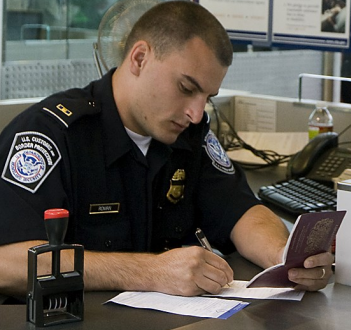
Recently I stumbled on a Bryan Caplan blog post I remember reading a couple years ago, about a businessman who was refused entry to the US purely on the basis of a technicality with his visa. The businessman, Tim Worstall, had a valid business visitor’s visa which he’d used several times before without issue. On this occasion, he was refused entry because US immigration officers just felt he ought to have a different visa in order to enter the US. They held him for interrogation without a lawyer, without recording what was said. An officer wrote an account of what happened from memory, and forced Worstall to sign this account, despite Worstall’s protests that it was inaccurate, because he “was told that if [he] did not [he] would be deported, [his] passport declared invalid for travel to the US for the rest of [his] life.” Worstall concludes:

There is no law, evidence, representation nor even accurate recording of proceedings in such “voluntary departures”. It is entirely at the whim of the agents at the border post. I was actually told by one agent “I’m gonna screw you over”. Something of a difference from what’s scrawled over that statue in New York really.

The comments are interesting; quite a few people seem horrified by the lack of due process in these proceedings. But they are really just par for the course. As I’ve written before, US consular officers essentially have dictatorial discretion in denying visa applications. Border agents have similar authority. In the comments on Caplan’s post, a Pierre Honeyman wrote about how one unprofessional US border officer arbitrarily reduced the validity of his 1-year work visa to 2 weeks, and arbitrarily invalidated the work visas of several of his colleagues.

There was another commenter, one Brian, who argued that some fault must lie with the victims of arbitrary immigration policies:

Don’t perjure yourself by signing a false statement. Don’t do or say suspicious or clever things to hostile and armed agents of a cruel and nasty government. Demand access to a supervisor, a lawyer and a judge, even if they tell you you’re not entitled to them. Have some friends expecting you who know to demand answers from local officials. Never say or do anything whatsoever in the USA without advice from a good lawyer.

I’m not sure how often Brian crosses international borders, but this is really something easier said than done. I’ve been crossing borders since young, and few things strike more fear in my heart than dealing with immigration agents, even though I know I’ve done nothing morally wrong (I’ve never crossed a border unlawfully, never been deported, never had any trouble with the law, in fact). A simple typo in your immigration papers can ruin your life. This is as true outside the US as it is in the US, though this problem is especially pernicious there.

Demanding access to a lawyer in US immigration proceedings is easier said than done, especially when you’re trying to enter lawfully. US deportation proceedings are no beacon of due process or justice, but even those subject to deportation have more legal rights than foreigners trying to enter lawfully do. Worstall could have refused to sign false statements and demanded a lawyer all he liked — the fact is, given US immigration agents’ dictatorial discretion, all of this would have been in vain. Standard principles of due process and fair trials which most of us in civilised societies take for granted simply don’t apply.

(None of this is to say we ought to blame the individual professional civil servants in immigration bureaucracies. The worst personal encounters I’ve had with immigration bureaucrats have been limited to facing mildly unpleasant demeanours; the best have been quite helpful and pleasant. But the professional conduct of individuals can never excuse the corruptness of the system that employs them.)

I don’t think it’s an accident that immigration laws are so inhumane, arbitrary, and unjust. US legal scholars note that this dictatorial discretion offered to individual US government employees stems directly from the US judicial precedent of Chae Chan Ping v. United States — better known as the Chinese Exclusion Case. As one of them says:

Reliance on the Chinese Exclusion Case is a bit like reliance on Dred Scott v. Sandford or Plessy v. Ferguson [two since overturned cases which similarly sanctioned government bigotry and prejudice]. Although the Supreme Court has never expressly overruled the Chinese Exclusion Case, it represents a discredited page in the country’s constitutional history.

When we base our laws on the moral principle that foreigners have no rights worth respecting, it should not be surprising that due process and a fair trial are consigned to the dust heap. When we base our laws on the moral principle that we can do whatever we like to foreigners who come in peace, it should not surprise us that foreigners try to come in peace without getting our attention and immigrate illegally.

Americans love to complain about government bureaucracies like the TSA, the IRS, or the DMV. At least those bureaucracies actually have rules they need to follow and can’t arbitrarily decide you really should pay more taxes than what the law says, or you really should have a driving licence for only 1 year instead of the usual 5 years, or you really need an anal probe before you board that train. Immigrants live in fear of a bureaucracy that’s worse, more powerful, and more arbitrary than the TSA, the IRS, and the DMV combined — and because they’re foreigners, we’ve apparently decided that that is perfectly fine.