Croatia, the EU, and Yet Another Experiment in Open Borders

Yesterday Croatia became the 28th member of the European Union. In doing so joined Europe’s great experiment in free trade and free immigration across diverse languages, beliefs, and cultures. The EU is not without its issues, but creating a large open borders region across Europe has not been the reason countries like Greece, Spain, Italy, Portugal, and Ireland have gotten into trouble.

Croatia is currently looking at a  18% unemployment rate and increasing options to move to a country like Germany with its 5% rate should be welcome. There are limitations still in place however. Croats won’t be able to go work in the United Kingdom for another seven years, and the country won’t enter the passport-less Schengen Area until 2015 at the earliest. Part of being able to do means clamping down harder on the country’s borders with countries outside the EU, a process that will require some significant investments.

Joining the EU probably won’t solve all Croatia’s current woes. But every person from Croatia who gets to try life somewhere else in Europe, and every European who finds a place to live or work in Croatia is a little improvement in the world. And every time a country opens itself up to freer migration without causing disaster the empirical case for open borders gets just a little stronger.

Women and Open Borders

TRIGGER WARNING: Some of the links contain graphic descriptions of rape, assault, and other forms of abuse.

In May, Christine Pelosi, chair of the California Democratic Party Women’s Caucus, urged feminists to support “immigrants’ rights as women’s rights” and “push for the most women-friendly immigration bill possible.”  She also observed that “many women’s rights advocates don’t see immigrants’ rights as a ‘women’s issue’ either out of privilege or unfamiliarity.”  Ms. Pelosi is correct about the overlap between immigration policy and the welfare of many women, although she doesn’t identify the best way to help women around the world: open borders policies in Western countries.

Before addressing how open borders could help women, I would like to observe that, just as many feminists may not concern themselves with “immigrants’ rights,” there is a dearth of women writing in support of open borders.  None of the contributors to this site are women.  Among those authors supporting open borders who don’t appear on this site, Vipul identifies only three women: Teresa Hayter, Jacqueline Stevens, and Aviva Chomsky.  (Harriet Grimsditch, a founding member of No One Is Illegal UK, can also be added.) (Ms. Chomsky’s support of open borders has to be inferred.  In her book  “They Take Our Jobs” and 20 Other Myths About Immigration (2007), she writes that “the decriminalization of border crossing would encourage almost all would-be immigrants to pass through established inspection stations…” (p. 190))  It is unclear why women are significantly underrepresented in authoring arguments in favor of open borders.  (It is interesting that a survey of global public opinion showed no gender differences in views on immigration policy.)

Open borders potentially could benefit women even more than men.  Like men, women would benefit from the economic opportunities made available by open borders and, conversely, be released from the various hardships imposed by restrictionism such as deportation, detention, separation from family, fear, exploitation, and being forced to remain in their home countries.

In addition, given the special plight of many women in many developing countries (and some wealthier countries, like Saudi Arabia) open borders would provide a crucial means of escaping their societies for the safety and freedom of the Western world.  In their book Half the Sky: Turning Oppression Into Opportunity For Women Worldwide (2009), Nicholas Kristof and Sheryl WuDunn write that “in this century the paramount moral challenge will be the struggle for gender equality in the developing world.” (p. xvii)  They ask, “Why is acid thrown in women’s faces, but not in men’s?  Why are women so much more likely to be stripped naked and sexually humiliated than men?  Why is it that in many cultures, old men are respected as patriarchs, while old women are taken outside the village to die of thirst or to be eaten by wild animals?  Granted, in the societies where these abuses take place, men also suffer more violence than males do in America–but the brutality inflicted on women is particularly widespread, cruel, and lethal.” (p. 67)

As Mr. Kristof and Ms. WuDunn suggest, many women around the world face widespread violence.  Some of the perpetrators are family members.  While domestic violence certainly exists in the U.S. and other Western countries, it is more pronounced and more tolerated in certain societies.  A Guatemalan lawyer claims that over a decade in her country, more than 4,000 women were killed in domestic violence, and only 2 percent of these cases had been solved.  Mr. Kristof and Ms. WuDunn describe the case of Zoya Najabi, an Afghan who was married at age twelve to a sixteen year old boy and who reported that “‘Not only my husband, but his brother, his mother, and her sister–they all beat me…’”  Mr. Kristof and Ms. WuDunn note that “the worst moment came when Zoya’s mother-in-law was beating her and Zoya unthinkingly kicked back.  Resisting a mother-in-law is an outrageous sin.  First, Zoya’s husband dug out an electric cable and flogged his wife until she fell unconscious.  Then, the next day, her father-in-law strapped Zoya’s feet together, tied her down, and gave a stick to the mother-in-law, who whipped the soles of Zoya’s feet.  ‘My feet were beaten until they were like yogurt,’ Zoya said.” (pp. 68-69)  Two other Afghan women were beaten each day for a week by their uncle and cousins, under their father’s supervision, for refusing to marry cousins. (pp. 156-157) Another form of domestic violence in parts of the world involves “honor” killings.  Sometimes, write Mr. Kristof and Ms. WuDunn,  “… a family kills one of its own girls because she has behaved immodestly or has fallen in love with a man…” (p. 82)  They estimate that there are at least 6,000 honor killings each year.

Women are threatened by strangers as well, with little protection from law enforcement.  In the Ethiopian countryside, according to the Mr. Kristof and Ms. WuDunn, “…if a young man has an eye on a girl but doesn’t have a bride price (the equivalent of a dowry, but paid by the man), or if he doubts that the girl’s family will accept him, then he and several friends kidnap the girl, and he rapes her.  That immediately improves his bargaining position, because she is ruined and will have difficulty marrying anyone else.  The risks to the boy are minimal, since the girl’s parents never prosecute the rapist–that would aggravate the harm to their daughter’s reputation and would be resented in the community as a breach of tradition.”  Until 2005, the authors note that “Ethiopian law explicitly provided that a man could not be prosecuted for violating a woman or girl he later married.” (62)   Similarly, a Mexican woman related how a man “… made her live with him, and forced her to have sex with him by putting a gun or a machete to her head, by breaking her nose and by threatening to kill the small children of her sister.  Once when she became pregnant, she said, she barely escaped alive after he had poured kerosene on the bed where she was sleeping and ignited it…  Local police dismissed her reports of violence as a ‘private matter,’ the court documents said, and a judge she turned to for help tried to seduce her.  ‘In Mexico, men believe they have a right to abuse their women because they are like a possession,’ she said.”   Mr. Kristof and Ms. DuWunn report that in Pakistan authorities are indifferent  “to injustices suffered by the poor and uneducated.”  They quote a gynecologist in Karachi who treats poor young girls who have been raped, usually by wealthy perpetrators: “‘When I treat rape victims, I tell the girls not to go to the police… Because if a girl goes to the police, the police will rape her.’” (pp. 83-84)

Mr. Kristof and Ms. DuWunn note that some recent conflicts, including those in Sudan, Sierra Leone, Liberia, and Congo, have involved mass rapes. (p. 83) Even after the conflict ended in Liberia, the predation against women persisted.  According to Mr. Kristof, the war there “seems to have shattered norms and trained some men to think that when they want sex, they need simply to overpower a girl.  Or at school, girls sometimes find that to get good grades, they must have sex with their teachers.”  During the war it was estimated that 75 percent of the country’s women had been raped.  “The incidence of rape has dropped since then but is still numbingly high.  An International Rescue Committee survey in 2007 found that about 12 percent of girls aged 17 and under acknowledged having been sexually abused in some way in the previous 18 months.”

Another harm women face in some societies is genital mutilation.  According to a U.S. court ruling, “The practice of genital cutting, a tradition throughout sub-Saharan Africa, has long been criticized by human rights groups and the United Nations and frequently takes place under unsanitary conditions, with tools like knives, scissors, razor blades and shards of glass…”  Alima Traore, who is from Mali, had endured this mutilation as a child  and applied for asylum in the U.S.  She said this about the U.S.:  “’It is a better place for women than Mali, because in Mali women don’t have any voice… Because it is the men who control.’”  Other African women who were victims of genital mutilation have also sought asylum in the U.S.

Governments severely restrict women’s freedoms in some countries.  In the Sudan, women are prohibited from wearing pants and are flogged for doing so.  In Saudi Arabia, women “need permission from their husbands or fathers to work, travel, study or even receive health care.  They cannot drive.  While more than half of the university students are women, their job prospects are severely limited.”    A woman can be whipped for being alone with a man to whom she is not married.  In Iran, the government in 2007 cracked down on “un-Islamic dress” and detained 150,000 women for violating the dress code.

Ending oppressive laws and the violence inflicted upon women in many countries is a formidable undertaking and a goal that could take a long time to realize, if ever.  A way Western countries could relatively quickly help women in these harsh situations is to open up their borders.  This probably would not mean a mass exodus of mistreated women to Western countries, since, as Mr. Kristof and Ms. DuWunn suggest, some of these women may be comfortable with the status quo: “… women themselves absorb and transmit misogynistic values, just as men do.  This is not a tidy world of tyrannical men and victimized women, but a messier realm of oppressive social customs adhered to by men and women alike.” (p. 69)  And obtaining the resources and arranging the logistics for those who wish to leave would be a challenge.  This is where those in the West concerned about the situation of women in these countries could help by providing shelters and financial help to women seeking to emigrate.  In some situations in which societies and families would be hostile to such interventions, a kind of modern day Underground Railroad system could be established to help women flee.  But first an open borders policy needs to be established to guarantee that those women who want to escape from their societies could find refuge in countries that respect them as women and people.  (Open borders would also allow victimizers to enter Western countries, but Western laws and institutions would better protect immigrant women than those in their home countries.)

Currently, for women seeking refugee in the U.S., the Center for Gender & Refugee Studies notes that U.S. immigration law has often been unfriendly to women seeking asylum based on gender related harm. “Decision-makers often fail to recognize that harms unique to women — such as forced marriage or honor killings — may constitute persecution.”  In 2009, a Mexican woman was killed by a former boyfriend shortly after being forced to return to Mexico by U.S. agents.  In an article in the Columbia Human Rights Law Review, the author relates the case of an asylum seeker from Guinea:  “… a woman was told that she would marry her uncle’s friend, who was fifty years older and already had four wives. When she objected, her uncle beat her. She escaped briefly, but upon her return was again beaten before the imam and then before the tribal elders, all of whom instructed her to proceed with the marriage. In addition, her uncle threatened to kill her should she persist in her refusal. The woman was finally able to escape and apply for asylum in the United States. Despite her credible testimony, the immigration judge denied the woman’s claim… He did not address the various forms of coercion being brought to bear upon her, or whether a marriage entered under such duress would constitute future persecution.” (p. 91)

The realization of open borders would benefit numerous women economically and/or enable them to escape from oppressive situations in their home countries.  To help make open borders a reality, more men and women in the West need to join this effort.

Weekly link roundup 1

This post begins a series of weekly link roundups for links across the web to a diverse range of content. The linked content need not have been published in the past week. As always, linking does not imply endorsement.

Oh, the absurdity of thinking that open borders demands open citizenship

One of the most common misconceptions I encounter in discussing open borders is the casual conflation of open borders with open citizenship. For something I consider an incredibly elementary distinction, this apparently eludes plenty of intelligent people. For example, here is EconLog blogger Art Carden casually saying:

An answer to Bryan’s question about how the government should spend a billion dollars. I’m going to take “give it back to the taxpayers” and “print a few hundred million US passports for prospective immigrants” off the table.

Bryan Caplan is one of the most famous and vocal open borders advocates around; he is Carden’s co-blogger. And yet it apparently seems to have escaped Carden that Caplan has never suggested printing US passports for foreigners. Caplan and the rest of the open borders movement want people to be free to move across borders. And you don’t need a US passport to cross the US border! You just need a valid US visa.

People worried that immigrants are going to abuse their welfare system or cast uninformed votes if we open the borders completely ignore that there are millions of foreigners today who legally cross borders whose access to welfare and the vote are curtailed, if not eliminated, by their visa restrictions. This is true in the US, and it is true in virtually any other country you care to name.

This is why I find the pervasive belief that it’ll be impossible to keep citizenship out of the hands of foreigners so puzzling. Surely people realise that in the US, as in most countries, you don’t need to be a citizen to work or settle now. Why would this change under open borders?

The distinction between open borders and open citizenship is critical. If you assume the first implies the second, you still need to clarify why exactly you believe allowing people to move to your country means you would be forced to give them citizenship. When I raise this distinction, I encounter two types of responses:

  1. A total avoidance of the distinction (i.e. the person persists in assuming you need to be a citizen of a country to live there)
  2. A confident certainty that either:
    1. Immigrants would rise up politically to demand and then acquire citizenship
    2. It would be simply immoral to admit a lot of immigrants and not give them citizenship

For scenario #1, I confess I am lost. It’s possible the fault lies with me in failing to communicate the distinction between passports and visas, between citizen and legal immigrant. But how can we best communicate this distinction? Any ideas?

For the scenarios in #2, let’s use US data, because it’s most conveniently at hand (thank you, my Dartmouth classmate Harry Enten!). In general, only 60% of US legal permanent residents naturalise. For those who were given legal immigrant status by the last major US amnesty, in 1986, only 40% naturalised. In short, almost 1 in 2 legal US immigrants don’t really want citizenship.

And right now, it’s fairly straightforward to acquire US citizenship once you’ve met the simple residency requirement of 5 years; the hardest parts tend to be learning English (if you don’t speak it), learning the material on the citizenship test (a bore, but certainly a doable challenge for most), and putting together the necessary paperwork to show you’re not a criminal, etc. It seems highly questionable to me to claim that these people would have rioted if they’d been admitted legally but under a different, stricter residency requirement.

And on that point, I don’t see any moral reason why the requirement for naturalisation has to be 5 years; it could easily be 15, or even longer. The harm to immigrants from this is minimal. Other than the vote and welfare, most people in the US, lawfully present or not, have identical rights and responsibilities. In fact, the only meaningful harm I can think of is that non-citizens can be deported and citizens can’t be. But the whole point of open borders is that, barring evidence that you are a danger of some kind, you should be able to go where you like. Once we protect non-citizens from arbitrary deportation, the moral harm of raising the bar for citizenship seems almost non-existent. It certainly pales in comparison to the moral harm of keeping people out of your country at gunpoint because you’re afraid letting them in might morally obligate you to throw a blank passport at them.

The question of whether such a moral obligation exists is something worthy of a whole book. But I don’t see a reason why crossing over an arbitrary line should suddenly make people on the other side of that line obligated to give you the vote. Citizenship is fundamentally related to who you are, not where you live, although the two are clearly related. I think most people intuitively understand this, since I don’t see anyone seriously demanding that every person on a student visa or a work permit in a foreign country be permitted to vote there. And I think it shouldn’t be hard to intuitively see that something is wrong with us if we insist on forcefully keeping people jobless and starving because we’re afraid the only alternative is giving them the vote. You don’t need to be a voter to hold down a paying job or rent your own home. So why impose that absurd and arbitrary requirement on someone else?

I am for open borders. I am not for open citizenship. There is a difference, and let’s be clear about that. One is about the fundamental human right to live and work without needing to beg any government for permission to stay in your own home or work for your employer. The other is about the less fundamental political right to cast a vote. The two are not the same, and blurring the difference between them does not serve us well.

Immigration and Cobb-Douglas: A Response to Eric Rasmusen

Tyler Cowen recently linked to a piece by Eric Rasmusen about potential scenarios where immigration hurts the American economy.

Rasmusen considers a few variations on the Cobb-Douglas production function where the amount produced by the economy is given by the equation: $latex Q=L^{.7}K^{.3}$ where L is the total amount of labor and K is the amount of capital available for production.

According to this model, if L = 100 and K = 100, the total production is 100. Of this amount, 70 is divided among the laborers and 30 goes to owners of capital. If L increases to 140 due to immigration and K remains constant, total production increases to 126.6. 38 of this goes to capital, 63.3 goes to native labor and 25.3 goes to immigrant labor. So capital wins and native labor loses. The amount capital gains is a bit more than the amount native labor loses.

This is a pretty standard analysis, but we should note that it assumes that K remains constant. This is the sophisticated equivalent of assuming that the number of jobs is constant, so that when immigrants enter the country they take “our” jobs. In fact, the amount of capital devoted to production depends on demand, which depends on the number of consumers. Since immigrants are consumers in addition to laboersr, we can expect the amount of capital devoted to production to increase.

But this isn’t the biggest complaint I have with the paper. In his analysis of the standard Cobb-Douglas approach, Rasumsen makes some very confusing comments about the impact of taking the welfare of immigrants into consideration:

“What about the benefit to immigrants? Some readers will want to include those in the policy objective for the United States… Although American labor definitely loses, immigrant labor either wins or is unaffected. The aggregate benefit to labor can be negative because if foreign wages are just a little bit lower than American post-immigration wages, then the gain to the immigrant labor is very small, while the loss to American labor is unaffected and therefore exceeds the immigrant gain. In fact, one might expect that if there is open immigration and the amount of immigration is 40, it must be that wages in the other country are .63, i.e., immigration stops at 40 because foreign and American wages equalize. Suppose further that the rest of the world is large compared to America, so that the rise in wages elsewhere in the world as a result of emigration to America is trivial. Then, the immigrants have neither gained nor lost by immigrating to America. The only welfare effects are the loss to American workers and the gain to American capital-owners.”

This analysis is baffling. If we are using the Cobb-Douglas model to understand the impact of immigration on the US, let’s use the same model to understand the global impact. In particular, let’s assume that we have two countries. In the US, L=100 and K=100, so Q=100 just like in Rasmusen’s model. But then let’s assume that there is one other country where labor and capital are out of balance. That is, L = 1000 and K=50 with the result that Q=407.1. Total production between the two countries is 507.1. Now what happens if we open the borders between the two countries? Then we can combine L and K so that L=1100 and K=150. But we don’t simply add the Q’s. In fact, total production is now 605.1. We got an additional 98 production for free!

How did that happen? We even assumed that the US contribution to K didn’t go up in response to the open borders, a likely result that would push the numbers up even more (if K went all the way up too 1100, then production would go up to 1100 as well). The reason is that the best way to maximize output under the Cobb-Douglas model is to evenly distribute the capital among laborers, not to split it up in disproportionate pieces.

Of course, it remains true that if we prevent K from going up then native labor will suffer. In the closed borders regime, the 100 native laborers received a wage of .7 each and the 1000 foreign laborers got .284. Under the open borders regime, all laborers got a wage of .38. Again, this is because we assumed that K remained constant.

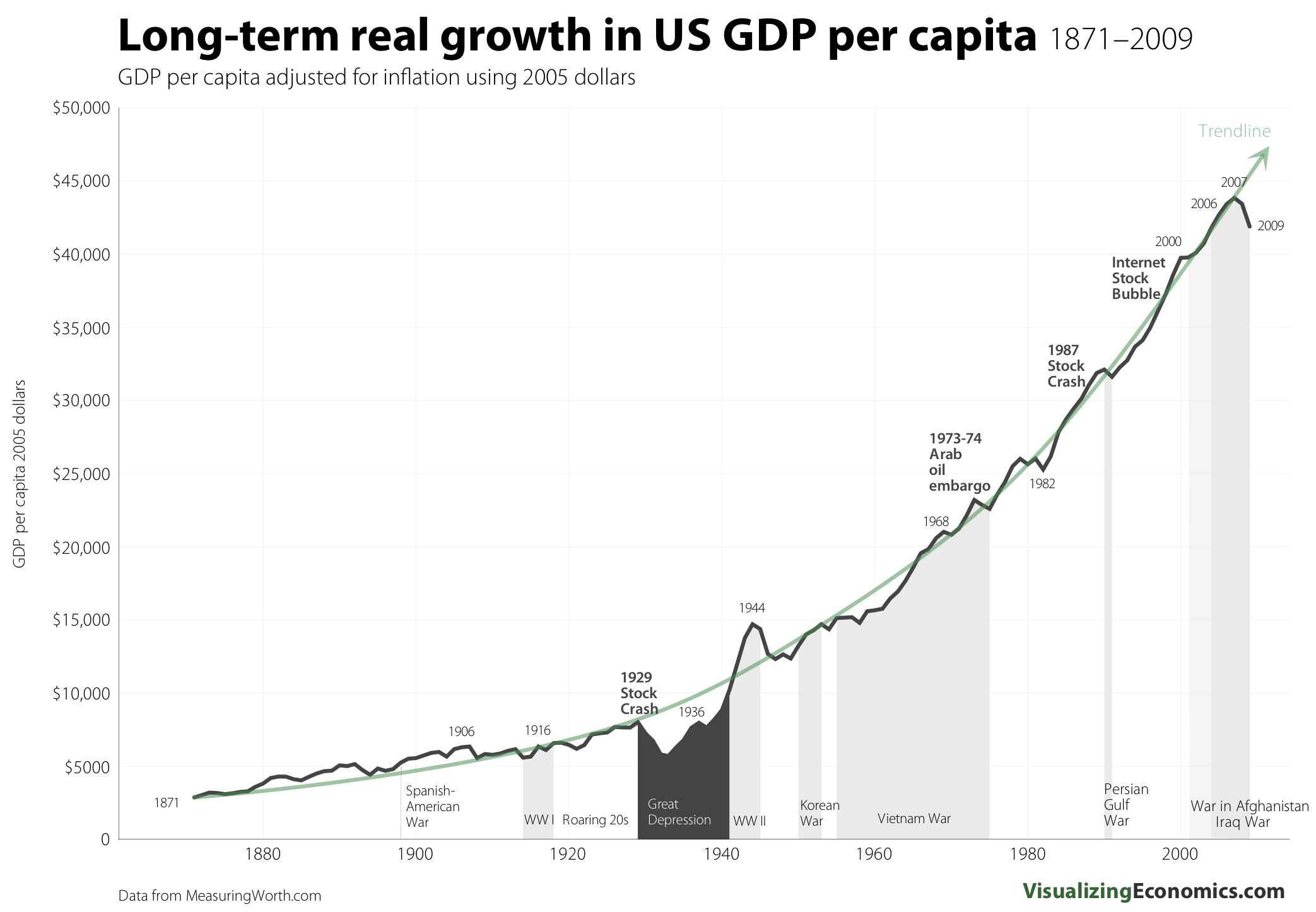
Rasmusen includes a few other scenarios in which not only does native labor lose, but net American output per person goes down. The most plausible of these is a scenario in which he assumes that the production function is a modified Cobb-Douglas function $latex Q=(L^{.7}K^{.3})^{.8}$, which represents the idea that we have diminishing returns to the combination of labor and capital. This could be due to a fixed amount of natural resources or land. In the basic model, the amount capital gains is more than the amount native labor loses. With this modified model, the amount capital gains from immigration is less than the amount lost by native labor.

The problem with this model is that it seems to run counter to experience. It would imply that as our population grows, there would be a very strong tendency for GDP per capita to decrease. That is, the result is not specific to immigration. It applies to any form of population increase. Our population has been growing steadily the nation was founded. Here is a graphic showing the results for GDP per capita:

Of course, Rasmusen doesn’t argue that any of his models actually represents reality. He is trying to explore scenarios in which immigration creates a net economic detriment to natives. In the basic model, cash transfers from capital to labor (e.g., progressive taxation) can be used to compensate native labor. In the modified scenario, the net loss to natives prevents such a program from working. Luckily, the model doesn’t seem very realistic, at least based on our historical experience.