International Tiebout competition

A major reason for skepticism about open borders among many who are partially sympathetic is the fear that poor immigrants will vote for redistribution. Natives might benefit, on average, from their interaction with immigration in the market, but in the political arena, poor immigrants with little to lose will vote for higher taxes and government handouts, making natives worse off. To deny immigrants the vote would solve this problem in theory, but raises other philosophical issues about the meaning of consent of the governed, and in any case might not be politically sustainable. Opportunistic parties might hand out citizenship to immigrants who they hope will be their future constituency. Immigrants might also take advantage of their physical presence to agitate in the streets for the vote and/or directly for the government benefits they hope to win by it. In short, open borders will make government more redistributive.

But the logic of Tiebout competition points the other way. Tiebout (1956) famously argues that local governments will provide public goods efficiently if people are free to move among jurisdictions, and concludes that we can expect public goods to be provided more efficiently at the local level than at the national level. Caplan recently explained where Tiebout goes wrong: (1) local governments are not perfectly competitive but face downward-sloping demand curves for residence and so can extract monopoly rents; (2) emigrants can’t take their real estate with them so bad local governments will reduce property values; and (3) local governments aren’t for-profit corporations and don’t face the incentives that for-profit corporations do to give customers/residents what they want. All good points, but there’s still something to be said for “voting with the feet.” Local governments may not be profit-maximizing firms, but they still differ in their performance, and people do get some choice over what local public goods they want by deciding where to live. In the short run, local misgovernment may depress property values more than inducing migration, but in the long run, capital can be adjusted, and misgoverned places can revert to weeds while well-governed places teem with new high-rises. And local governments are still somewhat competitive.

In the Tiebout model, government provides public goods rather than engaging in redistribution. The people who choose to live in a location don’t mind paying for what the government does, because they regard the benefits as greater than costs. If not, they would move. The government might charge the rich more than the poor, if it’s still providing the rich value for money, and especially if the rich value local public goods more, in money terms, than the poor do, which is plausible, since they presumably get less marginal utility from a dollar but might not get less marginal utility from a statue in the park or clean air or good streetlights. But if the government charges the rich too high a price for local public goods, they’ll move to a jurisdiction with lower taxes, and explicit redistribution is ruled out by the exit option.

Garett Jones has pointed out that a comparison of state tax regimes with federal tax regimes seems to support (loosely) the Tiebout model. See “Can Progressivity Survive Exit?”:

I should note though, that while state taxation is regressive in percentages, it’s progressive in dollars.  And that’s the point of my tweet: Higher earners pay more than lower earners even though they could leave.  Perhaps some of that is altruism, but I suspect-without-proof that most of it is just that the rich (and middle class) buy more and better government services than the poor.
It’s possible that progressive income taxation could coexist with voluntary competitive government. Maybe the high-skilled need to be near each other to produce a lot, so the locales preferred by the rich can tax that demand for proximity.  The (not very progressive) New York City income tax comes to mind.But at the national level, I suspect that the reason the rich pay higher total tax rates is mostly because it’s hard to leave the nation.  Easy targets.

Jones also points to the French government’s retreat on capital gains taxes as a victory for “[the] Tiebout [model against] progressivity” (I think that’s what the title of his post means). And here he entertains the suggestion that the fact that European tax systems are much less progressive than America’s is explained by Tiebout competition. Since the EU has open borders, wealthy elites can shop among jurisdictions. I don’t know enough about European tax politics to affirm or deny the causal link here, but it fits the theory. An international comparison of corporate tax rates also suggests that Tiebout competition is at work. From the Tax Foundation’s blog, here are “Corporate Income Tax Rates Around the World.”

Country Corporate Tax Rate in 2000[1] Rank in 2000 Corporate Tax Rate in 2006 Rank in March 2006
Japan 40.9 3 39.5 1
United States[2] 39.4 6 39.3 2
Germany 52 1 38.9 3
Canada 44.6 2 36.1 4
France 37.8 7 35 5
Spain 35 11 35 5
Belgium 40.2 4 34 7
Italy 37 9 33 8
New Zealand 33 16 33 8
Greece 40 5 32 10
Netherlands 35 11 31.5 11
Luxembourg 37.5 8 30.4 12
Mexico 35 11 30 13
Australia 34 14 30 13
Turkey 33 16 30 13
United Kingdom 30 21 30 13
Denmark 32 18 28 17
Norway 28 26 28 17
Sweden 28 26 28 17
Portugal 35.2 10 27.5 20
Korea 30.8 20 27.5 20
Czech Republic 31 19 26 22
Finland 29 24 26 22
Austria 34 14 25 24
Switzerland 24.9 28 21.3 25
Poland 30 21 19 26
Slovak Republic 29 24 19 26
Iceland 30 21 18 28
Hungary 18 30 16 29
Ireland 24 29 12.5 30
OECD Average[3] 33.6 28.7

Note that the US has the second-highest (after Japan) corporate income tax rate in the OECD. This is counter-intuitive, since ideologically the US has a reputation for being free-marketeer and pro-business, with a comparatively thin welfare state and less regulation. But if international Tiebout competition is at work, this pattern is sort of what you’d expect. The US is big and geographically isolated, so corporations based in the US won’t find it very easy to hop the border. European countries face steeper competition from other jurisdictions, so companies are relatively mobile.

Open borders would make international Tiebout competition a more effective force for disciplining governments’ redistributive impulses. But here I don’t mean primarily unilateral open borders, nor open borders with very poor countries. The US government is not likely to cut taxes on the wealthy for fear that they’ll emigrate to Rwanda, or even Mexico. But it might someday cut taxes to keep the wealthy from moving to Hong Kong, or Italy, or some yet-to-be-founded futuristic free charter city. If the right to emigrate were made a global reality, international Tiebout competition might start to matter a lot.


Continue reading International Tiebout competition

True stories from immigration law: US citizens have no right to be with their spouses

The US legal doctrine of consular nonreviewability leads to over a million people being refused visas every year, with no legal avenue to challenge the consular officer’s decision, no matter how arbitrary, prejudiced, or groundless it may be. But beyond affecting these foreigners’ lives, there are real effects on US citizens too. One effect of racial segregation which social justice discussions often gloss over is how unjust laws oppressed not just the visible immediate victims, but also others, ostensibly privileged, who wished to engage with the oppressed. Such is the case with immigration laws around the world today. US legal precedent is especially enlightening here.

Filipino-Hawaiian lawyer Emmanuel Samonte Tipon last year blogged a useful overview of relevant cases touching on when someone might have legal standing to sue for judicial review of a visa application. Let’s go over them one by one.

  1. Sabataityte v. Powell: Sabataityte was denied a visa because the Warsaw consulate believed she had been previously unlawfully present in the US. She challenged this determination. The courts ruled that regardless of the merits, she had no right to mount such a challenge.
  2. Saavedra Bruno v. Albright: Saavedra was denied a visa, and had another visa revoked, because the US government believed he had previously illicitly trafficked drugs (based on a hit when they searched his name in a database). This was news to Saavedra and his American employer, both of whom sued the government to present the evidence so they could challenge the determination that he was a drug trafficker. The courts ruled that both Saavedra and his American employer had no legal basis to confront the claims against him or challenge the visa refusal.
  3. Hermina Sague v. United States: Sague, a citizen, married Berger, a Frenchman, and applied to permit him to enter the US so they could live together as a family. The government denied Berger a visa, and Sague sued, insisting she had a right as a citizen to live with her husband in the US. The courts ruled that it was impossible to challenge the consular refusal and moreover, based on legal precedent, “there is no constitutional right of a citizen spouse … to have her alien spouse enter the United States.” Perhaps even more perversely, “once an alien has entered our jurisdiction, even illegally, he may only be expelled after proceedings conforming to the traditional standards of fairness encompassed in due process of law. However … ‘an alien on the threshold of initial entry stands on a different footing.'” In other words, if you want due process, you need to enter the US illegally.
  4. Centeno v. Shultz: Centeno, a Filipino citizen, applied for a visa to visit his American family, and was denied. He and Coane, his American brother-in-law, sued to appeal this decision, arguing that the decision was arbitrary and violated Coane’s first amendment rights to engage in discussion with his brother-in-law. (You laugh, but violation of citizens’ first amendment rights is one of the few grounds citizens have to challenge consular officers’ decisions.) The US Court of Appeal essentially laughed Centeno and Coane out of court in a one-page decision.
  5. Patel v. Reno: Patel, a US citizen, applied for visas for his non-citizen wife and children. The government, suspecting Patel had obtained citizenship by fraudulent means, instructed the consulate in Mumbai to place Patel’s application in limbo, where it laid for 8 years. The courts ruled that since no final decision had been made, this visa application was subject to judicial review. Since the application had been in suspended state for 8 years, the courts ordered the consulate to make a final decision on whether to grant the application within 30 days. At the same time, the courts affirmed that not even the Secretary of State had the power to overturn the visa decision once it had been made.
  6. Kleindienst v. Mandel: A seminal case in US immigration law. Mandel was a Belgian Marxist who had travelled to the US many times to speak. In 1969 he applied for a visa and was refused on grounds of his politics. He and the citizens who had invited him to speak sued, citing amongst other factors, the government’s denial of the citizens’ first amendment rights to freedom of speech. The Supreme Court eventually ruled that an infringement of first amendment rights could be grounds for judicial review; broadly, the consular decision on a visa application must have “a facially legitimate and bona fide reason”. Immigration lawyers regard this as a landmark case for immigrant rights, but in reality, the Supreme Court went on to say that allowing Mandel his visa on first amendment grounds risked destroying the doctrine of consular nonreviewability, since by definition virtually all immigration restrictions infringe on citizens’ first amendment rights. The court then held that Mandel was not entitled to judicial review of the consular decision.
  7. Udugampola v. Jacobs: Udugampola, a US citizen, applied for an immigrant visa for her non-citizen father. The government initially approved the petition, but at the consular interview, the officer there denied the visa because he suspected her father of terrorism. Udugampola and her mother (also a legal immigrant to the US) sued the government. The courts ruled that neither Udugampola’s rights as a daughter nor her mother’s rights as a wife were constitutionally-protected in this case, and they had no basis to challenge the consular decision.

A common thread runs through all these: no matter whose interest are at stake, there is virtually no right to question a consular decision, even if it is based on flimsy evidence or is egregiously wrong. Even if it splits up a marriage, the government has absolute totalitarian power. And these are just the cases which get as far as prominent courts in the US. How many thousands of families must there be, lives ruined by immigration law, around the world? How can any self-respecting person in this day and age reconcile the outright disdain immigration law has for our families and communities with modern ideals of liberty and human rights?

The photograph featured at the top of this post is of Mario Chavez embracing his wife Lizeth through the US-Mexico border fence at Playas de Tijuana. The original photograph is copyright David Maung, and was published by Human Rights Watch; a higher-resolution version is available at their website.


Immigrants Are Attracted to Jobs, Not Welfare

This post was originally published on the Cato-at-Liberty blog here and is republished with the permission of the author.

Unauthorized and low skilled immigrants are attracted to America’s labor markets, not the size of welfare benefits.  From 2003 through 2012, many unauthorized immigrants were attracted to work in the housing market.  Housing starts demanded a large number of workers fill those jobs.  As many as 27 percent of them were unauthorized immigrants in some states.  Additionally, jobs that indirectly supported the construction of new houses also attracted many lower skilled immigrant workers.

Apprehensions of illegal crossers on the Southwest border (SWB) is a good indication of the size of the unauthorized immigrant flow into the United States.  The chart below shows apprehensions on the SWB and housing starts in each quarter:


Fewer housing starts create fewer construction jobs that attract fewer crossings and, therefore, fewer SWB apprehensions.  The correlation holds before and after the mid-2006 housing collapse. 

What about welfare? 

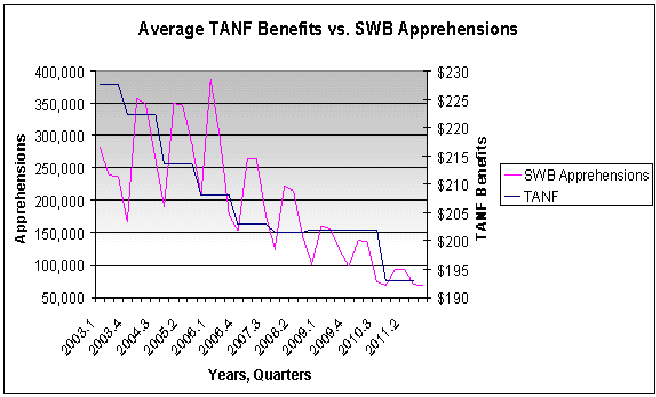
Here is a chart of the national real average TANF benefit level per family of three from 2003 to 2011 (2012 data is unavailable) and SWB apprehensions:


Prior to mid-2006, TANF benefit levels fell while unauthorized immigration rose.  During the housing construction boom, unauthorized immigrants were attracted by jobs and not declining TANF benefits.  After mid-2006, when housing starts began falling dramatically, real TANF benefit levels and unauthorized immigration both fell at the same time.  If unauthorized immigration was primarily incentivized by the real value of welfare benefits, it would have fallen continuously since 2003.   

The above chart does not capture the full size of welfare benefits or how rapidly other welfare programs increased beginning in 2008.  As economist Casey Mulligan explained in his book The Redistribution Recession, unemployment insurance, food stamps (SNAP), and Medicaid benefits increased in value and duration beginning in mid-2008.  Including those would skew welfare benefits upward in 2008 and beyond, but unauthorized immigration inflows still fell during that time.

In conclusion, housing starts incentivize unauthorized immigration while TANF does not. 

The progress of freedom

This will be a bold claim, but I think that much of the history of the progress of freedom is summarized in three general patterns:

  1. Accountability vs. sovereignty.
  2. Separation of solidarity from violence.
  3. Rights flow from insiders to outsiders.

Clearly these need some explication.

  1. Accountability vs. sovereignty. By sovereignty, I mean the separation of rulers from the ruled, the claim of certain persons or organizations to be above the law, not answerable for following the moral rules that most people expect one another to abide by. Sovereignty appears to be primordial: at the dawn of history, we see the absolutist phaorohs elevating themselves to divine status and commandeering the labor of Egypt to build them spectacular tombs. The opposite principle, accountability, means people having to render an account, and the hearers of the account being placed, in some way and degree, in a position to judge the adequacy of the account. Accountability is subjection to the moral law. The slogan “a government of laws not men” is one way of putting the struggle of sovereignty vs. accountability. Under sovereignty, accountability consists in the subject being accountable to the sovereign, not the other way around. To make the sovereign accountable creates logical difficulties and a danger of an infinite regress, which is why thinkers like Thomas Hobbes are contemptuous of it, but in fact roundabout, tangled-up, ambiguous, confusing systems of accountability make the framework of freedom in which civilization flourishes. Senate, House of Representatives, Supreme Court, states, Federal Reserve, common law… Who’s in charge here?! There’s no answer, and that’s the point. Nowadays, democracy is taken to be the touchstone of legitimacy, and perhaps the dimly understood yet potent reason for this is that democratic accountability gives the regress somewhere to stop. “Who’s in charge here? The people,” says the democrat. But in truth, elections can’t and shouldn’t be the whole story of accountability: can’t, because of all the logical problems with democratic decision-making noted by (among many others) Buchanan and Tullock (1962) and Arrow (1951/1970); and shouldn’t, because when “the people” do agree, they might agree on doing something very bad, like segregation or slavery or electing Hitler. It’s good if the power of the people to get what they want is hedged about and constrained by courts that protect individual rights and economic technocrats to manage the money supply and international treaties that protect foreigners from the whims of domestic majorities and churches and civil disobedience movements that appeal to higher laws and stand ready to defy the democratic state when it is in the wrong.
  2. Separation of solidarity from violence. The word “solidarity” is not part of an economist’s usual vocabulary, and I don’t find it easy to define, but I think it’s historically important. Solidarity is people working together in pursuit of a common goal. Solidarity is people bonding, forming a group, a shared identity. Solidarity is fans rooting for the local sports team, friends helping one another move house, wearing the school colors or waving the flag or singing the family’s favorite song. An economist, habituated to methodological individualism, or a libertarian, adhering to an individualistic ideology, might want to dispense with it, with the practice, with the concept. It’s a part of human nature and human history. It’s also necessary to achieve all sorts of good ends– even including the cohesion of profit-seeking firms. Miller (1993) painstakingly shows how it’s impossible to arrange incentives within a firm so that the interests of all the individuals who comprise the firm coincide with those of the firm as a whole (in whatever sense). Doubtless, firms are shot through with misaligned incentives and conflicts of interest and operate inefficiently for that reason, but surely there is also a good deal of genuine team spirit and corporate loyalty and forgetfulness of self-interest, in short, solidarity, in firms, that makes them run better than they otherwise could. Of course, this applies more obviously to ideological groupings in civil society– Cato Institute fundraisers doubtless appeal to solidarity when asking donors for cash– as well as churches, nations, and so on. Of course, solidarity is not at all an unmitigated good. It is often a great evil, or at least a means to great, evil ends: the solidarity of white southerners against black civil rights; or the solidarity of the Germans under Hitler against the Jews. Now, at the dawn of history, it seems that solidarity was usually bound up with violence, in two senses: (a) it was in the crucible of war that solidarity was chiefly formed, and (b) the maintenance of solidarity was typically backed up by threats of violence. Of course, this is true even today: the solidarity of the Anglo-American alliance, a crucial historical force in the 20th century, owes much to their fighting two world wars together; the solidarity of the United States itself owes much to various wars going starting with the Revolution, and was also sealed in the Civil War, which set a precedent that perhaps deters would-be secessionists even today by a threat of violence. But as civilization advances more and more forms of solidarity arise that are independent of violence: the Christian church (perhaps ultimately the fountainhead of them all); the monastic orders of the Middle Ages; the “associations” whose abundance Tocqueville celebrated when he visited America in the 1830s; the teeming NGOs of today. Most striking of all, perhaps, are the great civil disobedience movements: Gandhi’s satyagraha campaigns; Martin Luther King’s marchers; and Polish Solidarity, which brought about the fall of communism. But also schools and political parties and sports clubs and, as I said, firms. As freedom progresses, more and more of the groups with which we identify ourselves are consensual. Some institutions, like families, largely retain their form but become more consensual in character, while others, like feudal suzerain-vassal hierarchies or ethnic tribes, vanish, and new, more consensual institutions appear.
  3. Rights flow from insiders to outsiders. Societies entirely lacking in justice and rights seem rare in history, though perhaps that’s only because they don’t produce much that’s worth remembering. Stalin’s Soviet Union, where even, or especially, top Communist leaders were routinely liquidated, might be an example of a society from which every vestige or simulacrum of justice had been utterly erased. Perhaps phaoronic Egypt was like that, I don’t know. But more often, some clique or set around the centers of power enjoys rights and conduct within it is shared by some norms or standards of justice, only no one thinks these norms apply to outsiders. In The Iliad, the Greek heroes appear to have no scruples about seizing women as sexual prizes and raping the wives of the Trojans, yet they do have some sense of justice among themselves, and Agamemnon, when he seizes a girl whom the army had allotted to Achilles, is definitely thought to be in the wrong. The progress of freedom often consists in the extension of rights established among themselves by some clique or inner circle to more and more of those outside the circle. The impressive freedom of speech which existed among the Greek heroes in The Iliad, but which did not extend to the ranks of common soldiers, was later, in the democratic revolution in Athens, extended to the whole people. Early 19th-century Americans prided themselves on their freedom, but did not grant the same freedom to black slaves or Indians. Later on, these freedoms were extended to all Americans. Constitutional government in England began with the Magna Carta, when the barons demanded and won recognition of their rights from the king, but as time passed, the liberties of the English, from habeas corpus to (much later) the vote, were extended to all Englishmen.

In view of these patterns, open borders can be seen as a natural next step in the progress of freedom.

  1. My co-blogger John Lee, in posts like this and this, highlights the arbitrariness and lack of accountability in immigration enforcement. Discretionary exercise of consular authority to exclude and deport people is an anomalous bastion of unaccountable sovereignty, a bewildering and often shocking exception to “government by laws, not men.” But to abolish discretion would be to recognize some sort of right to migrate, which virtually implies open borders, at least in an attenuated form.
  2. In immigration restrictions, solidarity continues to express itself in the form of violence against outsiders. We are we, therefore they must go. The maintenance of our collective identity somehow depends on the expulsion by force of foreign-born persons, the separation of families, the splitting up of communities, etc. The long transition from violent to peaceful forms of solidarity suggests that history will tend to move away from this.
  3. Open borders consists of extending some of rights of citizens, won in part through political struggle but demanded ex ante and recognized ex post as the requirements of justice quite apart from historical contingencies, to the foreign-born.

I don’t mean to say that open borders are inevitable. Logically, I don’t see why the progress of freedom should be inevitable, and while history gives considerable reason for optimism, it also shows that vast backsliding is possible. The early modern period in most of Europe seems to have seen a major reversal of the progress of freedom that had been attained in the High Middle Ages. Slavery, which had largely disappeared in medieval Europe, began again in the New World. Absolutist sovereignty gained ground at the expense of medieval accountability, with its patchwork of customary and feudal rights, including the parliaments and Cortes and Estates-General and zemskiy sobor and so on, which were eviscerated or ceased to be summoned. This was true even in England to some extent before 1640. Again, a major reversal in the progress of freedom occurred in the early 20th century, from which in some respects we have yet to recover. But open borders is the sort of advance that the progress of freedom, when it happens, has historically tended to realize.    Continue reading The progress of freedom

It Can’t All Be About (the) U.S.

In February, National Public Radio aired a segment, part of its Planet Money series, in which it asked three immigration experts what sort of immigration system they would have if they “controlled the borders.” To NPR’s credit, one of the experts was the Cato Institute’s Alex Nowrasteh (a contributor to the Open Borders site). He proposed letting all immigrants in, except for suspected terrorists, criminals, and those with serious communicable diseases. He noted that this policy would benefit the economy and would mean that people wouldn’t have to put themselves at risk crossing the border.

Not surprisingly, the other two experts chosen by NPR did not propose open borders. One expert was the economist Giovanni Peri, a professor of economics at the University of California, Davis, who has researched the economic impact of immigration on the U.S. and found it to be mostly positive. His ideal immigration system would be one in which employers would bid for permits allowing them to employ individual foreign workers, including low-skilled workers. The other expert was Dean Baker, co-director of the Center for Economic and Policy Research (we’ve critiqued Baker before). He would admit immigrants with families in the U.S. and would provide visas to highly skilled individuals who, in the words of NPR’s host, “would benefit our economy the most.” Mr. Baker said he “would like to make sure that you had a lot of immigrants at the high end” but is “less concerned about farm workers.”

The proposals from Mr. Peri and Mr. Baker seem designed to maximally benefit the U.S. and apparently make the interests of immigrants who are excluded from their systems irrelevant. Formulating such an immigration policy probably makes sense to many Americans. After all, some may think, the government should look out first and foremost for the interests of its citizens. Joseph Carens of the University of Toronto articulates this view: “The power to admit or exclude aliens is inherent in sovereignty and essential for any political community. Every state has the legal and moral right to exercise that power in pursuit of its own national interest…”

Mr. Carens suggests, however, that this nationalist position doesn’t justify immigration restrictions. He explains that “When the stakes are high (e.g., legal proceedings) we normally create institutional rules to try to prevent people from being able to favor their friends and relatives. In other words, our notion of justice constrain the extent and ways in which we think it is acceptable for us to favor family members… even if we are morally entitled to favor compatriots in some ways, it is not self evident that we are entitled to favor them by excluding potential immigrants. Perhaps that form of preferential treatment goes too far.” Restricting immigration in effect would be nepotism writ large, an attempt to favor those identified as being more closely connected to us by giving them access to the U.S. labor market and denying access to those deemed less connected.

Bryan Caplan of George Mason University (who has also guest blogged for Open Borders) echoes Mr. Carens in his critique of the analogy between the nation and a family: “…almost everyone recognizes moral strictures against familial favoritism.  Almost everyone knows that ‘It would help my son’ is not a good reason to commit murder, break someone’s arm, or steal.  Indeed, almost everyone knows that ‘It would help my son’ is not a good reason for even petty offenses – like judging a Tae Kwon Do tournament unfairly because your son’s a contestant.” Despite this, Mr. Caplan points out that at the national level citizens tend to lose this sense of morality and use nationalism “as an acceptable excuse for horrific crimes against outgroups.” Nationalism leads to immoral treatment, such as interfering with the right to immigrate.  The logic of Mr. Carens and Mr. Caplan discredits nationalist arguments around the world supporting immigration restrictions, not just those in the American context.

Given Planet Money’s focus on economics, the underlying question posed to the three experts about their preferred immigration regime may really have been: “From a purely economic standpoint, which immigration policy do you believe would most benefit current American citizens?” (Even within these parameters, the proposals of Mr. Peri and Mr. Baker are questionable; open borders, as Mr. Nowrasteh suggests, may have the most beneficial economic impact on the U.S.) Actual policymaking, however, should not exclude moral concerns. NPR should air another segment asking guests, “What would be a moral immigration policy?” That would help Americans think more profoundly about immigration policy.