
What if foreigners could vote in US elections?

I’ve sometimes wondered why foreigners can’t vote in US elections. “What?” you ask. “Why should they be able to? That’s crazy!” Well, they do have a stake in it. Many of them pay attention to US elections. They are affected by the outcomes of US elections. To grant foreigners the right to vote in US elections might seem, prima facie, to be obviously against the interests of US voters, whose ability to choose their own government would be diluted. Yes, but what if it were reciprocal?

For example, suppose that the US and Canada made an agreement, whereby every Canadian got 1/5th of a vote in every US election, and every American got 1/5th of a vote in every Canadian election. Never mind the electoral college and whatnot for now, just think of the math. If there are 300 million Americans and 20 million Canadians (close enough for now), Canadian votes would have a pretty small weight in US elections, while American votes could potentially dominate Canadian elections. Canadians might still take the deal, though, if US policies affect them heavily and they want to have a say. On issues of domestic policy without international ramifications, it might not matter much: Canadians wouldn’t have reason to care about them one way or the other. But there would probably be narrow issues, say fishing rights in the North Pacific, which might be important to many Canadian voters and not on Americans’ radar screens at all. It’s not that such issues would decide US elections; rather, US politicians would flip pre-emptively to prevent them from doing so. It might lead to more harmonious international relations and stronger alliances. For haters of George W. Bush, consider this: he wouldn’t have had a chance if every European got 1/5th of a vote. But for supporters of the War on Terror, consider this: there would be a lot more Tony Blairs, and a lot fewer Jacques Chiracs, in the world. Free trade would almost certainly benefit. So might collaboration on global public goods, e.g., CO2 emissions, NATO military spending, international transfers and foreign aid. It could lead to more funding for science, which has positive spillovers. Americans voting in German elections would ignore many German domestic issues but might respond to appeals for funding science and technology, or protecting patents.

The effects are hard to predict, but one thing, I think, is almost certain: It would lead to much more freedom of migration. Suppose the issue is: how easily will American issue work visas to Canadians? Americans will know virtually nothing about the issue. Canadians will know a lot. An American candidate’s share of the Canadian vote would depend heavily on his position on the Canadian visas issue. The issue would probably have very little visibility in the US. Even if the Canadian vote was small– say 1 million effective votes, compared to 100 million cast in the US– it would be well worth gaining at such a negligible cost. By the same token, American voters would quickly secure for themselves the right to work in Canada. And it would not be a question of annexation. Canada would still have an independent government, as would the US.

My co-blogger John Lee is good at evoking horror at the arbitrariness, the fundamental neglect of basic justice and human rights, of which immigration systems are guilty. I think a little democracy would take care of this in a hurry. US consuls would not remain mini-dictators for long if foreigners had a say in the matter. Gratuitous, senseless, cruel visa denials would go viral among foreigners, and politicians would look for ways to make the process tolerably just to appease the foreign vote, with its small but far from insignificant weight, and probable unanimity.

The idea of foreigners voting in US elections, and vice versa, is at once simple and unheard-of, which makes me suspicious of it. If it’s as good an idea as it seems at first glance, why haven’t I heard anyone else suggest it? But I can’t see what is wrong with it. It seems like it could actually be Pareto-improving, its main effect being to correct policies that injure foreigners out of all proportion to any benefits they provide to natives. Immigration restrictions are the most obvious case, but foreign policy, global public goods, and trade restrictions are other examples. I think the idea deserves to be part of the conversation.
More on immigration and the Bible

Post by Nathan Smith (regular blogger for the site, joined April 2012). See:

From my reading of the Old Testament, it’s quite clear that the Bible supports open borders, full stop. But I should acknowledge that this isn’t the consensus view. Here is an article that claims “The Bible Gives No Sanction to Open Borders.” The author, John Vinson, is in blockquotes, I’m not.

For religionists sympathetic to mass immigration, legal and illegal, Old Testament Bible verses saying “welcome the stranger” and “love the stranger” are the ultimate trump cards and justification for their position. This absolute certitude is ironic when it comes, as it often does, from religious liberals who commonly regard much of the Old Testament as Hebrew mythology, with little authority to command ethical obedience in the modern world. The Old Testament’s condemnations of homosexuality, for example, carry little weight with these liberals, if indeed they notice them at all.

I don’t think I’m one of the religious liberals Vinson is talking about, but anyway, one can accept that the Bible teaches something and not advocate making that the policy of contemporary states. I think the Old Testament provides a pretty good template for immigration policy, though not one that exactly corresponds to what I’d prescribe. I don’t want us to return to the Mosaic law when it comes to religious freedom (worshipping pagan gods could be punished by death) or slavery (permitted under the Mosaic law, albeit in an ameliorated form), or marriage (polygamy was tolerated).

In contrast, their literalistic embrace of “welcome the stranger” without reference to context or scholarship is characteristic of the uninformed dogmatism they often attribute to fundamentalists and other Christian conservatives. In fairness, this characteristic sometimes is true, but the general tendency of people who take the Bible seriously is to weigh verses carefully from every standpoint of learning and insight.

Yes, as long as you’re not just using that as an excuse to pretend the Bible says what’s convenient for you to have it say.

One who has done so on the pro-stranger verses is biblical scholar and archeologist James K. Hoffmeier. In his book The Immigration CrisisImmigrants, Aliens, and the Bible, Hoffmeier sheds a great deal of light on these verses and the issue of immigration from a biblical perspective. Hoffmeier convincingly argues that Middle Eastern peoples in biblical times controlled their borders and regulated immigration much as countries do today. Among them was ancient Israel.

To understand how Israel’s system worked, Hoffmeier shows, one must understand the meanings of different Hebrew words which English Bibles translate as “stranger,” as well as “foreigner,” and “alien.” The passages that command hospitality, love, and protection toward people so named use the Hebrew word “ger.” The ger, says Hoffmeier, was what today we would call an alien with permanent resident status. The Bible specified that such persons were to enjoy most of the same rights as Israelites, while at the same time requiring that they obey the laws of Israel. But others called stranger, foreigner, and alien did not have these benefits or obligations. The Hebrew words from which they derive are “zar” and “nekar.”

I suppose Hoffmeier knows Hebrew and in that respect has an advantage over me. But I suspect he doesn’t know much about immigration policy if he thinks “Middle Eastern peoples in biblical times controlled their borders and regulated immigration much as countries do today.” Passport regimes are a peculiarly modern phenomenon. Open borders were the norm as recently as the 19th century.

Consequently, the modern day writers who claim that the Bible sanctions illegal immigration, by referencing the pro-stranger passages, are drawing a completely false analogy. The strangers in this context were legally admitted people who agreed to abide by the laws of the land.

The Biblical texts do suggest that resident foreigners were expected to abide by the Mosaic law. That they had “agreed” to do so does not seem to be the case, because some procedure would have to take place whereby they agreed, and no such procedure is discussed in the Mosaic law. And I don’t see how anyone could have read the Book of Judges and suppose that any legal infrastructure existed to “legally admit” people. In the Book of Ruth, it seems clear that she didn’t ask permission, but simply came. Neither rules nor administrative procedures for “legally admitting” people are defined in the law. I haven’t read Hoffmeier’s book, but it seems clear the Biblical ger were neither like modern legal immigrants, who have received permission from a sovereign government, nor like modern undocumented immigrants, whose presence is a violation of the law. They just came, and were expected to abide by the rules. Continue reading More on immigration and the Bible

Rand Paul’s interesting precedent

While I don’t generally buy into the views of Ron or Rand Paul on foreign policy, Rand Paul’s filibuster, which is being credited with giving new momentum to the GOP, sets a promising precedent. Paul’s insistence that the president has no constitutional authority to use drone strikes against Americans on US soil was morally obvious, yet at the same time profoundly subversive, since it implies that there are, after all, limits on state authority, and therefore that the doctrine of sovereignty in the pure Hobbesian sense is fall. Bravo! Interestingly, since the Republicans have a reputation as the hawkish party, strong on national security, Paul’s stand actually went against part of what Republicans identify with, but the political configuration allowed Paul to appear, sort of, as the voice of the GOP against the soulless statism of the Obama administration. Paul’s message was fundamentally the doctrine of human rights or natural rights: it’s wrong to kill innocent people, period.

It probably wouldn’t work right now, but one wonders whether at some point in the future, Republicans could be flip-flopped on the immigration issue with similar ease. If a Republican candidate opportunistically assailed the Obama administration for its draconian deportation policies, that would doubtless alienate some of the base, but the GOP might look like white knights and protectors of the weak, and become more popular in some quarters, and Republicans who aren’t particularly nativist might just embrace it. What’s at stake here is the moral high ground. Seizing it is really a lot of fun, and it can pay off in the oddest and most delightful ways.

Self-driving cars and undocumented immigration

Technology has altered migration patterns many times. New modes of transportation– railroads, faster and safer ships, cars, airplanes– made migration cheaper and easier. The internet and cheap international telephony have made it easier for migrants to stay plugged in to their home countries, and possibly discourage assimilation among migrants, though on the other hand, modern technology and cultural globalization probably encourage pre-assimilation. The internet also encourages international dating. What about the next transportation technology that seems to be in the pipeline, self-driving cars?

It’s always hard to foresee how new technologies will change society, the economy, and people’s way of life. But I’ll try. Self-driving cars probably won’t crowd out private car ownership anytime soon, but they will make it optional. A car sitting in a parking space is a waste. It’s a waste of both the car and the parking space. The taxi cab model uses cars and space more efficiently, but of course, it’s labor-intensive. Labor is expensive. That’s why even a short cab ride can cost $10-$15 or more. But a self-driving taxi cab could be much cheaper. In some ways, it would be more convenient as well. Presumably you could summon one with a smartphone, and order it to drop you off at the entrance of wherever it is you want to go. If you’ve been drinking, no problem. Also, you’re not require to drive the same car, day in, day out. Cab companies, with a much larger volume of business, could offer a large selection. Got a big load? Order a roomier vehicle. By yourself? Order a miniature one-car cab. Electric cars might benefit, because people wouldn’t suffer from “range anxiety.” Smartphones plus self-driving cars might allow for sophisticated forms of carpooling, with minivans planning out complex routes on the fly so as to serve many customers at the same time. Some parking lots would turn back into green spaces. It’s hard to say whether cities or suburbs will benefit more. Currently, it’s suburbanites who have to bear the burdens of car ownership. City dwellers can do without them, relying on public transit instead. On the other hand, city dwellers may be very glad to be able to get out of town at will, and to take a self-driving cab when they’re in a hurry, or late at night, instead of navigating buses and metros.

What does this have to do with immigration?

1. If long-distance cargo transport came to be dominated by self-driving trucks, that might complicate border control. Currently, it’s probably not too difficult for a US citizen to bring someone in by car across the Mexican border, hiding them in the trunk, say. But it’s risky, because if the driver gets caught, they can be punished. (I can’t seem to find out what the punishment is, but I think it’s pretty serious.) But what if there’s no driver? Maybe you could punish the owner, but what if you can’t find the owner, or can’t find out who the owner is? Or what if the owner says the illegal immigrant was there without his knowledge or permission?

2. Once undocumented immigrants arrive, one of the things that makes life difficult for them is that they might not be able to get drivers’ licenses. But in the age of self-driving cars, drivers’ licenses will no longer be a sine qua non of modern life, even in the suburbs. Many natives may not bother to get them. Undocumented immigrants will do just fine without them. They’ll have an unprecedented range of movement, without needing the fake papers.

3. Professions that involve home visits may be especially facilitated by self-driving cars. In jobs that involve a lot of time on the road, not having to be behind the wheel will be an immense blessing. The stressful and boring time spent watching the road can be spent socializing on Facebook, or studying, or watching movies, or taking classes, or maybe even doing some kind of paid work that can be done on a smartphone. Since undocumented workers seem disproportionately to be involved in driving-intensive jobs– housecleaning, landscaping, etc.– self-driving cars will make their lifestyles pleasanter. Perhaps that will even lure more of them to come. Those professions will also be easier to get into when one will no longer need a car, or a driver’s license.

Wedging a crack in trans-Atlantic borders: reforming the Visa Waiver Program

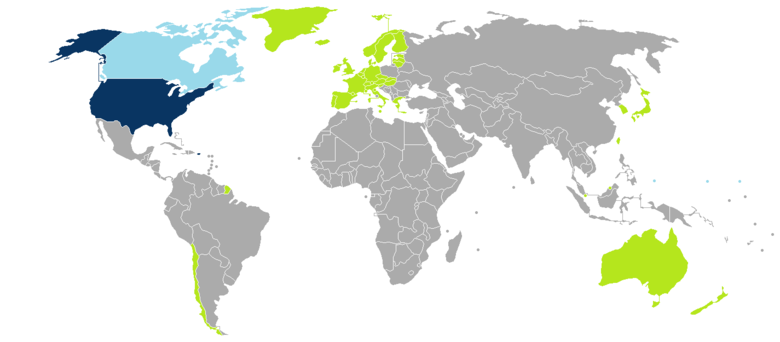
Credit for featured image: Wikimedia Commons. It shows in green the countries eligible for the US Visa Waiver Program. For more, see the Wikipedia article.

A few years ago, the South Carolina Journal of International Law and Business published an article by then-law and business student Robert Wilson on the risks that US visa policy poses to trans-Atlantic foreign relations. The article is a good and I think fair review of the case for and against stricter non-immigrant visa policy. Wilson never hides that he favours a looser policy, but he accurately notes the reasons why the US government has felt compelled to tighten the borders.

Wilson’s focus is on the US visa waiver programme (VWP) which allows people from certain countries to enter the US without a visa. They simply need to pass a quick (30 seconds is the figure he cites) check at border control. Wilson notes that this is how some of the 9/11 terrorists were able to enter the US. This is why since 9/11 the US has mandated interviews for almost all visa applicants, and why the US has been reluctant to extend the reach of the VWP.

I-94W

Visa Waiver Program I-94W form that any person from a VWP-eligible country needs to fill in when landing in the US for a short-term, VWP-eligible trip. Source: magazineUSA.com

But as Wilson notes, sealing the borders in this manner is not practical. It is not any more useful or pragmatic than demanding the search of every cargo container entering the US for bombs or drugs. Other than a cursory check at the border, the VWP essentially throws open US borders to eligible foreigners, with no obligation to present additional information prior to entry. And these foreigners are screened not on any meaningful factual basis other than national origin: an person from Nigeria has to face stringent checks prior to boarding a flight to the US, while an identical twin who happens to have British citizenship can waltz right on up to the border.

I am in favour of open borders, but this manner of implementing them strikes me as arbitrary and self-defeating. Just as there are safe ways to deregulate, there are also plenty of unsafe ways, and this arbitrary discrimination strikes me as just one such unsafe way. Wilson cites how the number of people travelling to the US for tourism and business has been falling since 9/11 because of stricter visa procedures, while equivalent figures for other countries have been trending up.

Wilson recommends the US pre-screen VWP-eligible foreigners, using a system similar to Australia’s. Nathan Sales, a law professor, testified before Congress that this approach would be much more sensible compared to the arbitrary status quo, and more importantly, would allow the US to expand the reach of the VWP. It makes sense to me: a government can legitimately limit entry at its borders if it justifiably believes that this addresses a concerning security risk. Refusing to submit basic biographical information or fill out a basic form signals that you are likely to be a risk of some kind.

I’ve used the Australian electronic equivalent of the VWP before: it’s straightforward and transparent. It’s not open borders, but I’d much rather have an extended visa waiver programme on a similar basis, open to as many people as possible. My belief is that the government should approve visas for anyone who is acting in good faith. Right now, the US denies visas to over 1 million people annually for essentially no reason (they’re not criminals, not carrying communicable diseases, etc.). Give those 1 million people the visas they need to visit or study.

One final point Wilson raises is that expanding the VWP to all the European countries who desire it would allow cooperation with those countries in immigration enforcement. By coordinating governance systems in this area, the US could more effectively deter people with outstanding criminal issues from entering, while opening the borders to those acting in good faith. If the US pursues this, this could eventually lead to trans-Atlantic open borders: even if border controls remain, visas would be available to all good-faith visitors, and one day perhaps even workers or immigrants.