How Does Immigration Impact Wages?

This post was originally published on the Cato-at-Liberty blog here and is republished with the permission of the author.

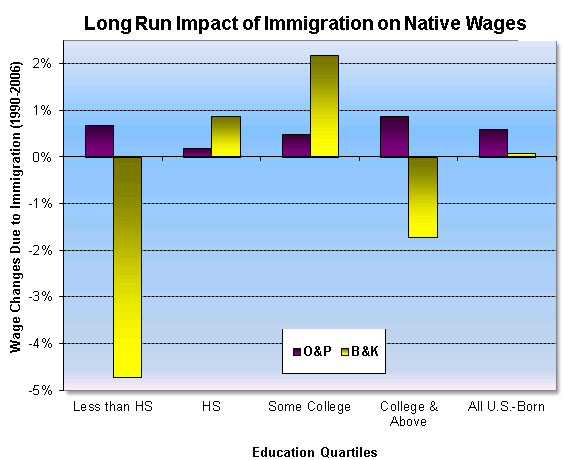
Many Americans are curious about the impact of immigration on the wages of other Americans.  The best research on this focuses on the period between 1990 and 2006, when almost 17 million people immigrated to the U.S. lawfully and a net 12 million came unlawfully.  The first major study is by Borjas and Katz (B&K) and the second is by Ottaviano and Peri (O&P).  O&P borrowed much of B&K’s methodology.  Here are the long run findings:

B&K draw a more negative conclusion than O&P.  The main differences are that O&P assume capital adjusts quicker to increased labor abundance and immigrants are more complementary.  B&K’s paper reflects their assumptions about native-immigrant substitutability.  Since immigrants are more likely to have less than a high school degree and more likely to have a graduate or professional degree than natives, B&K’s model assumes natives in those categories are competing with immigrants for jobs and therefore experience wage declines. 

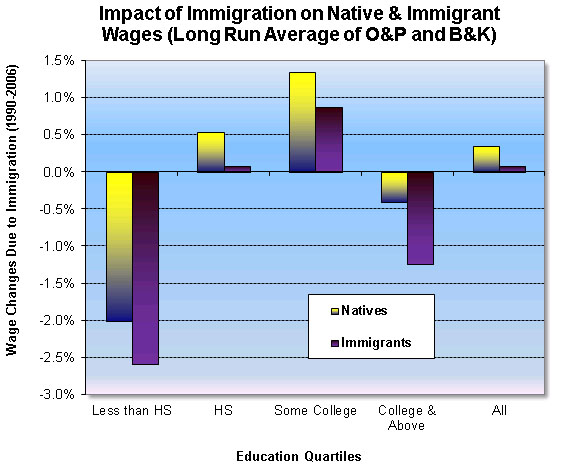
Both O&P and B&K found that increased immigration has a larger affect on immigrants than natives.  Depending on their level of education, longer settled immigrants experience greater wage declines and smaller wage gains from more recent immigration compared to natives:

Both sets of authors rightly assume that more recent waves of immigrants are most similar to immigrants from older waves, making the two arrival cohorts of immigrants substitutes in the workplace.  Recent papers by Ethan Lewis and Giovanni Peri and Sparber make convincing argument that language ability of recent immigrants makes them more similar and, thus, substitutable with previous waves of immigrants.  Language ability also makes immigrants complements to natives, partly explaining why O&P and B&K found wage increases for so many American workers as a result of immigration.

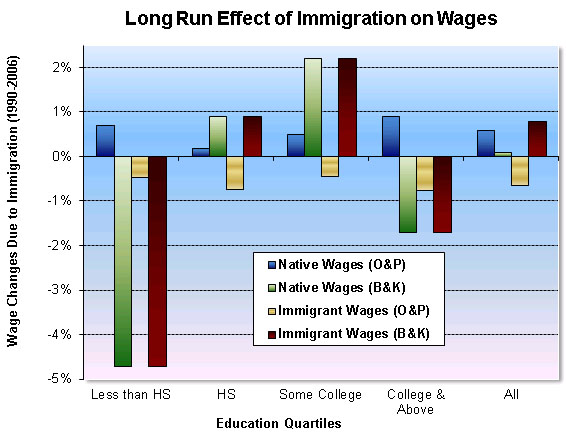
Here is a comparison of the long run wages effects on immigrants and natives from the O&P and B&K study:

These charts merely explain the results of previous waves of immigration on the American labor market.  If immigration increases in the future these numbers will likely be different but the past is always a useful guide for anticipating the effects of future policy changes.


Bibliography:

Borjas, George, “The Labor Demand Curve Is Downward Sloping: Reexamining the Impact of Immigration on the Labor Market.”

Borjas, George and Lawrence Katz, “The Evolution of the Mexican-Born Workforce in the United States.”

Ottaviano, Gianmarco and Giovanni Peri, “Immigration and National Wages: Clarifying the Theory and the Empirics.”

Peri, Giovanni and Chard Sparber, “Task Specialization, Immigration, and Wages.”

Lewis, Ethan, “Immigrant-Native Substitutability: The Role of Language Ability.”  

America Does Not Have A ‘Genius Glut’

This post was originally published on the Cato-at-Liberty blog here and is republished with the permission of the author.

On Friday, Ross Eisenbrey of the Economic Policy Institute wrote an op-ed in the New York Times titled “America’s Genius Glut,” in which he argued that highly-skilled immigrants make highly skilled Americans poorer. 

A common way for highly-skilled immigrants to enter the United States is on the H-1B temporary worker visa. 58 percent of workers who received their H-1B in 2011 had either a masters, professional, or doctorate degree. The unemployment rate for all workers in America with a college degree or greater in January 2013 is 3.7 percent, lower than the 4 percent average unemployment rate for that educational cohort in 2012. That unemployment rate is also the lowest of all the educational cohorts recorded. 

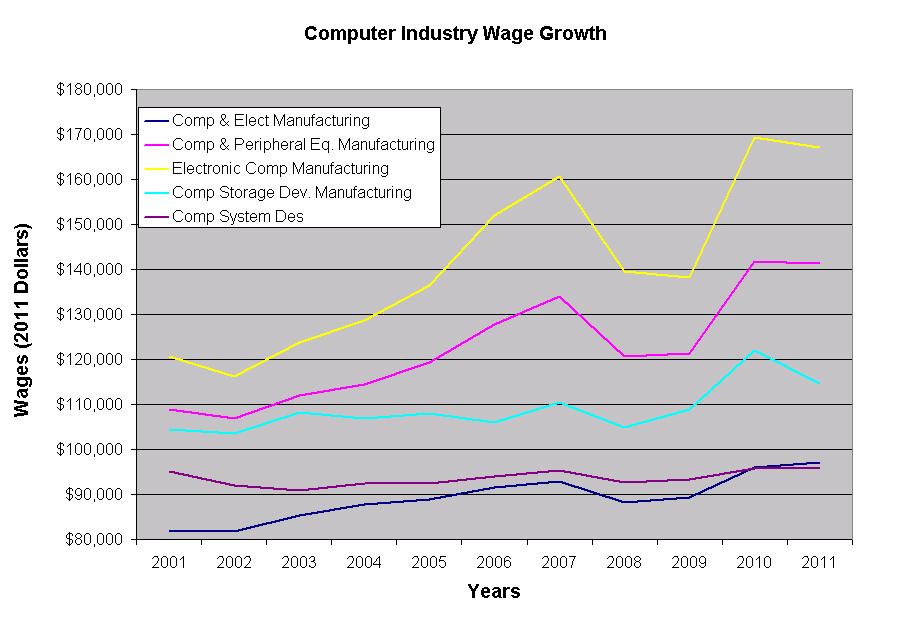
Just over half of all H-1B workers are employed in the computer industry. There is a 3.9 percent unemployment rate for computer and mathematical occupations in January 2013, and an unemployment rate of 3.8 percent for all professional and related occupations. For selected computer-related occupations from the Bureau of Labor Statistics’ “Quarterly Census of Employment and Wages,” real wage growth from 2001 to 2011 has been fairly steady:   


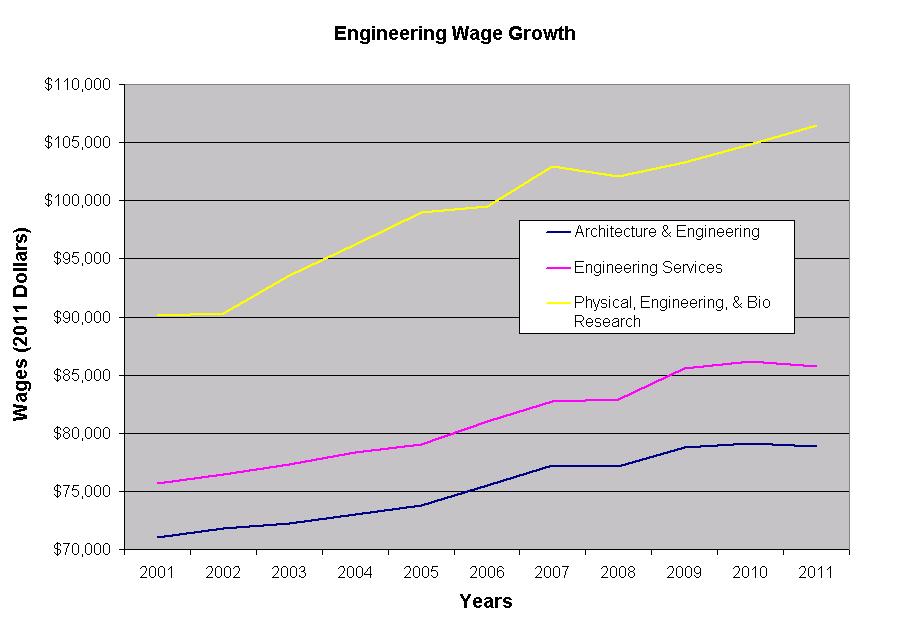
 11 percent of H-1B visas go to engineers and architects but wage growth in those occupations has been fairly steady too:


Mr. Eisenbrey concludes that those rising incomes would rise faster if there were fewer highly-skilled immigrants. 

The unemployment rates for engineers and computer professionals are low but not as low as they used to be. There are a whole host of factors explaining that, but highly-skilled immigration is not likely to be one.  

Mr. Eisenbrey also claims that American firms hire H-1B visa workers because they are paid lower wages. Complying with certain regulations prior to hiring an H-1B can cost a firm $10,000, filing and other fees can cost additional thousands of dollars, and legal fees can be steep. The cost of hiring H-1Bs is high.

Contradicting Mr. Eisenbrey’s story about H-1Bs lowering American wages, IT workers on H-1Bs actually earn more than similarly skilled Americans. According to survey data, H-1B workers are more willing to work long hours and relocate to a job, making them more productive and raising their wages. Additionally, H-1B engineers are paid $5,000 more a year than American born engineers. If the goal of employers was to hire cheaper workers through the H-1B visa, they’re going about it in an odd way. The high regulatory costs and wages of employing H-1B workers incentivizes firms to hire foreign workers when they are expanding and can’t find American workers fast enough.  

Mr. Eisenbrey’s doesn’t touch on other characteristics of highly-skilled immigrants such as their high rates of entrepreneurship, inventiveness, or skill complementarity. If the New York Times chooses not to run one of my letters to the editor about those topics, I will be writing about them in the upcoming weeks.

John Kennan’s “Open Borders”

This post is going to attempt to do something difficult, namely: bring a contribution to technical economic theory within reach of lay readers. The typical lay reader, or for that matter even an atypically intelligent reader who is not a specialist in economics, could understand little of Kennan’s paper, or for that matter most academic economics papers. I don’t totally understand the paper either, but I think I mostly understand it. I’m pretty sure I understand the main thrust. The work in question is “Open Borders” by John Kennan. If one had to pick one thing to stick in a newspaper headline, it would be Kennan’s prediction that

For the 40 countries in Figure 6 this gives an estimate of $10,798, per worker (including nonmigrants), per year (in 2012 dollars, adjusted for purchasing power parity). This is a very large number: the average income per worker in these countries is $8,633, so the gain in (net) income is 125%. For all of the countries in the Penn World Table that are not at the productivity frontier (as defined above), using GDP data to estimate relative wages, the estimated gain is $10,135, relative to an average income of $9,079, so the gain is 112%. These are of course just rough estimates, relying on a number of strong simplifying assumptions. But unless these assumptions are extremely far off the mark, the results indicate that the gains from open borders would be enormous.

In other words, open borders could double the income of the world’s most disadvantaged people. Far from causing a “brain drain” effect, harming poor countries by poaching productive people, even nonmigrants would benefit from open borders. Furthermore:

These gains are associated with a relatively small reduction in the real wage in developed countries, and even this effect disappears as the capital-labor ratio adjusts over time; indeed if immigration restrictions are relaxed gradually, allowing time for investment in physical capital to keep pace, there is no implied reduction in real wages.

How does Kennan arrive at this conclusion? Via a theoretical model, calibrated to fit certain real world data. The approach is oversimplified and crude, yet at the same time, in some ways, painstakingly subtle… but that’s economic theory for you. The logic must be impeccable, but economists’ tolerance for departures from realism can be opaque at first, then, once understood, rather shocking. But one has to do it. A question like “what would happen if the world opened its borders?” involves such a large departure from current reality that common sense and experience fail us. Theory can, so to speak, see in the dark. It allows us to keep thinking clearly, at least, about very remote situations. But down to business.

After a short intro, Kennan’s first really substantive paragraph is:

Before proceeding to analyze a world economy with open borders, the first question that must be answered is whether restrictions on factor mobility have any real effects. If product prices are the same across countries (because there is free trade and transportation is not costly, for example), and if there are two goods that are produced in two different countries, and if the production technologies (for these two goods) are the same across the two countries, then the factor price equalization theorem applies. That is, real wages and other factor prices are equalized across countries even though factors are immobile, because differences in factor prices are implicitly arbitraged through the product market. The theoretical argument is beautiful, but of course the facts are otherwise. For example, wages in the U.S. are about 2.5 times the Mexican wage, for comparable workers.

This will require some unpacking, especially “factor price equalization” and “differences in factor prices are implicitly arbitraged through the product market.” An important result in international economics is that in the “long run,” given certain fairly standard (albeit apparently unrealistic) assumptions, immigration will not reduce wages in the host country, because the mix of industries in the host country will shift to accommodate the new supply of workers to such an extent that wages will be exactly the same. (See the closely related Rybczynski theorem.) Thus, to use the example from the Feenstra and Taylor textbook that I teach this stuff out of, suppose there are two industries, computers and shoes. Computers are a capital-intensive industry, shoes a labor-intensive industry. If a lot of immigrants enter a country called, say, Home, then Home will start producing more shoes and fewer computers.

Fewer computers? Yes, fewer. Even though there are more workers? Not just proportionally fewer? No, fewer in absolute terms. Think of it this way. There’s the same amount of capital in Home as there was before. But there are now more workers. It’s not surprising that the shoe industry will take the lead in absorbing these workers, since its technology is the more labor-intensive of the two. But as it does so, it will lower the marginal product of labor and raise the marginal product of capital in the shoe industry. Or to try to express it without the jargon, the shoe industry will have trouble finding useful things for so many new workers to do without new machines, structures, and other capital goods for them to work with. Even if the shoe industry can’t increase its capital at all, it could find something for all the new workers to do. It will be able to make more shoes. But not that many more shoes. The greater supply of workers increases the shoe industry’s demand for capital. In fact, it implies that the shoe industry wants capital more, at the margin, than the computer industry does. As capital moves from the computer industry to the shoe industry, workers move too, since the scarcity of machines makes them less productive in computers. Importantly, the relative price of computers and shoes stays the same. This is because prices are pinned down by international trade: any deviation in the relative price would cause arbitrage. Wages don’t fall– again, this is in the long run– because relative prices don’t fall, and wages depend on relative prices. The growth of the shoe industry and the shrinkage of the computer industry raise the economy’s demand for labor relative to capital, exactly canceling out the tendency for a greater supply of labor to reduce its wage. This implies not only that wages shouldn’t be reduced by immigration, but also that wages should be the same in every country. Continue reading John Kennan’s “Open Borders”

Eisenbrey argues against increasing US visas for high-skilled work

Ross Eisenbrey of the Economic Policy Institute has written an op-ed in the New York Times titled “America’s Genius Glut” with the argument that the United States should not increase non-immigrant guest worker visas for (allegedly) high-skilled workers (the H1B visa category). Eisenbrey’s argument is thoughtful and nuanced, and he comes at this restrictionist conclusion from a more progressive stance than the majority of restrictionists I read (though, to be fair, many allegedly right-wing restrictionist groups often use very similar rhetorical arguments).

Below are my quick thoughts on Eisenbrey’s piece. These were written very quickly, hence my sincere apologies to Mr. Eisenbrey if I misrepresented his position. I’ve also tried to argue based on (what I understand to be) Mr. Eisenbrey’s framework of assumptions and goals, even though I don’t share them in many respects.

  • Eisenbrey writes:

    But America’s technology leadership is not, in fact, endangered. According to the economist Richard B. Freeman, the United States, with just 5 percent of the world’s population, employs a third of its high-tech researchers, accounts for 40 percent of its research and development, and publishes over a third of its science and engineering articles. And a marked new crop of billion-dollar high-tech companies has sprung up in Silicon Valley recently, without the help of an expanded guest-worker program.

    I’m in broad agreement with Eisenbrey that the United States (or for that matter, the world at large), is not at risk of systemic collapse if it fails to increase H1B quotas or relax the requirements for getting a H1B visa. I expect that things will keep getting better for the world, with or without open borders. I don’t think that Silicon Valley, or any other stereotypical high-skilled worker sector, is at risk of folding up due to a lack of immigrant labor. The current guest worker visa regime seems good enough to keep these sectors alive, though at the same time they may face competition from other jurisdictions outside the US that are easier to migrate to (see, for instance, here and here). Those who claim imminent collapse are probably mistaken.

    But while the crisis argument is misguided, that is hardly an argument for the status quo and hardly an argument against improvement. The relevant question to consider with any proposal is how it compares with the alternative, not whether it is absolutely necessary. So overall, while it’s valuable to point out what Eisenbrey did, the point of contention is still open to debate.

  • Eisenbrey writes:

    almost 90 percent of the Chinese students who earn science and technology doctorates in America stay here; the number is only slightly lower for Indians. If they’re talented enough to get a job here, they’re already almost guaranteed a visa.

    I think it’s true that the vast majority of high-skilled and qualified workers educated in the US can stay in the US if that is their primary aim. But not necessarily doing the job of their choice, or the job that would create the maximum value for society (from either a citizenist or universalist perspective). The existing H1B regime favors (in relative terms) large established companies that can afford the legal fees and other resources to help procure visas. Of course, this isn’t to say that these large established companies are favored in absolute terms — even these companies would prefer not to have to make these outlays. But what’s an inconvenience for large established companies can be a dealbreaker for startups and small companies. Also, the inflexibility of the guest worker visa program means that it’s difficult for workers to do short-run internships at companies before deciding whether to work there long-term, and other intermediate and flexible arrangements may also be ruled out. Many foreigners who want to create a startup, or work at one, or attempt a flexible arrangement of this sort may compromise either by not choosing to stay in the US, or working at a large company instead. John Lee’s recent post had some examples, see also the quote from Natalie MacNeil here or the story of entrepreneur Amit Aharoni.

  • Eisenbrey writes:

    If there is no shortage of high-tech workers, why would companies be pushing for more? Simple: workers under the H-1B program aren’t like domestic workers — because they have to be sponsored by an employer, they are more or less indentured, tied to their job and whatever wage the employer decides to give them.

    I’m not sure if, controlling for all relevant skill variables, this is true, but if, in fact, those on H1B visas get paid less than identically skilled natives, one simple explanation might be all the legal outlays, as well as uncertainty, associated with H1B hiring, which factor into the cost on the employer side but don’t actually reach the employee’s pocket. That’s the demand-side story. The supply of workers story is that workers prefer to take lower wages than natives that are still substantially higher than wages in their home country.

    Eisenbrey is also correct that guest worker programs that are tied to a single program lock workers in and may allow employers to offer lower wages to workers because of lower fear of exit. But this also cuts in another direction: employers aren’t able to “poach” such guest workers that easily from their competitors. Overall, I don’t think that the inflexible guest worker programs are all that beneficial to employers in the big picture (though you could make an argument that employers as a whole benefit modestly by keeping wages slightly lower than they would be in a market equilibrium, this effect would still be lower than the naive estimate due to greater friction in hiring employees from competitors). In any case, in so far as the proposal being critiqued by Eisenbrey fails to offer flexibility with respect to changing employers, this is a valid critique. However, in as much as it doesn’t make things worse than the status quo, I’m hard-pressed to see why Eisenbrey would oppose it. (note that most versions of guest worker programs proposed by open borders advocates allow for easy change of employers — see here and here).

  • Eisenbrey writes:

    Bringing over more — there are already 500,000 workers on H-1B visas — would obviously darken job prospects for America’s struggling young scientists and engineers.

    The citizenist connotations here are striking, but it would be pointless to critique citizenism yet again here. Still, there is an interesting question: to what extent does high-skilled immigrant labor depress the wages of high-skilled native labor? It’s hard to measure “skill” so most labor economists use proxies such as education level and type of degree. There are theoretical reasons to believe that many sectors using high-skilled work may enjoy more complementarity than substitution between different workers. At any rate, that’s my guess, as I mentioned here. But this is a controversial position. The most pessimistic estimate I’m aware of is that by George Borjas, which estimates that the last few decades of immigration have depressed the wages of college graduates by 3.9% in the short run and 0.5% in the long run (interestingly, in Borjas’s numbers, the only groups experiencing long run wage declines are college graduates and high school dropouts). I think that Borjas’s model by design ignores complementarities, making some of these conclusions suspect from my perspective, but this is something I’d need to examine far more closely than I’ve had time for so far.

    Now, obviously, the numbers could look a lot different under open borders. But Eisenbrey is talking of marginal changes to an existing system, not complete open borders. A 0.5% long run wage decline is nothing to be laughed at, but it is hardly a catastrophe, and not the same as destroying people’s livelihoods and life prospects.

  • Eisenbrey writes:

    But it would also hurt our efforts to produce more: if the message to American students is, “Don’t bother working hard for a high-tech degree, because we can import someone to do the job for less,” we could do significant long-term damage to the high-tech educational system we value so dearly.

    Although I’ve read many restrictionist arguments, this is a new one: immigration of high-skilled workers lowers the pay for high-skilled native workers, which lowers the payoff of acquiring high skills, which lowers people’s degree of education. I’d have to think a lot more about this to come up with a clear view on the matter, but offhand, this does seem plausible once you agree with the preceding claim that high-skilled immigration lowers high-skilled natives’ wages (again, in practice, we’ll proxy “high-skilled” with “college graduate” or something similar when measuring stuff).

    Still, if this is true, is this an additional reason to worry about high-skilled immigration? I don’t see why. If, for some reason (immigration or otherwise) the returns to high-skilled work fall, and people respond by pursuing less of education in those skill areas, this seems like an appropriate response to the changed economic conditions, that is both privately and socially beneficial. If you believe that education is mostly about signaling, then this is even more socially beneficial than it appears. The only way I see where you’d consider this bad is if you think either that people undervalue their own gains from education or if you think education confers significant social benefits over and above the private benefits it offers.

    The undervaluing story may be valid, but you’d then need to show that the extent to which people undervalue education also increases with a reduction in the return to education, which would seem somewhat self-contradictory and hard to show.

    I’m not opposed to the idea of significant social benefits to education (though my personal view is that it’s more than canceled by signaling, but let’s set that aside for now). However, if these significant social benefits exist in the form of positive spillovers, it seems prima facie plausible that educated guest workers would generate very similar positive spillovers, so this fails to be an additional argument against guest worker programs, even from a citizenist perspective.

UPDATE: Here’s a somewhat more forceful response from Alex Nowrasteh, that critiques some of the numerical and empirical claims made by Eisenbrey. Alex’s critique is largely complementary to mine (in that it covers a different set of points, with minor overlap).

Barry Goldwater’s vision of open borders

Goldwater is a name synonymous with the rebirth of American conservative, right-wing politics. But it is also a name that should be synonymous with open borders. In 1962, Barry Goldwater jotted down some thoughts on where his beloved Arizona would be in 50 years. On immigration and Mexico, he said:

Our ties with Mexico will be much more firmly established in 2012 because, sometime within the next 50 years, the Mexican border will become as the Canadian border, a free one, with the formalities and red tape of ingress and egress cut to a minimum so that the residents of both countries can travel back and forth across the line as if it were not there.

To a certain degree, his vision came true ahead of time. Stories of lively cross-border interactions pre-9/11 abound. After the post-9/11 crackdown on border movement, it became much harder to cross the Mexican border with the US without enduring much lengthier delays than existed before. Goldwater’s vision plainly does not exist today.

Of course, to some degree, one can argue that Goldwater wasn’t really arguing for true open borders (though I find it interesting that Goldwater pointedly refers to the “residents of both countries,” as opposed to just citizens). Canadians themselves face a fair number of immigration restrictions in the US. The popular television show How I Met Your Mother has made fun of this by depicting a Canadian character’s issues with her work visa forcing her to consider a sham marriage with a friend. This theme is fairly popular in the media, actually; Ryan Reynolds and Sandra Bullock starred in The Proposal, a film based on a very similar storyline, also about a Canadian woman forced into a sham marriage to hold down her job in the US.

These pop media depictions have a basis in reality. My current employer used to hire non-US residents frequently. It stopped doing this a few years ago not just because of the cost, but because of the immense uncertainty about whether a work visa would actually come through. It’s no use hiring someone only to have to bid goodbye to your tens of thousands of investment in that person’s training thanks to immigration enforcement. Canadians at my firm were no exception to this; I met someone who transferred to my office from our Toronto office very shortly before we stopped sponsoring work visas; he told me he actually decided to work for us in Toronto because he wanted to work in the US in the first place.

So no open borders for Canadians. But looking at Goldwater’s statement, I don’t think he would have expected the kinds of restrictions my Canadian colleagues put up with. One can hardly describe a convoluted work visa process as an immigration law that cuts the formalities of ingress and egress to a minimum. One can hardly say that Canadians can cross the US border as if it were not there! Maybe Goldwater was only imagining open borders for tourists, but that doesn’t sound like the sort of thing someone dreaming about the next 50 years of progress would be focused on.

Modern US conservatives would do well to hark back to Goldwater (and Ronald Reagan, for that matter, considering his willingness to embrace “amnesty”). The nature of North American trade and physical borders means closed North American borders are legislating against economic and geographic reality. Instead of trying to build an expensive and unrealistic wall, the sensible thing to do is to allow those acting in good faith to come and go — and monitor these legal movements carefully to filter out those with ill intent. In fact, this is a lesson from another famous US conservative’s Operation Wetback. Reflecting on Dwight Eisenhower’s policy, Alex Nowrasteh writes:

By the early 1950s many unauthorized migrants were entering alongside Braceros to work, mainly in Texas. The government responded with the now infamous Operation Wetback that removed almost 2 million unauthorized Mexicans in 1953 and 1954. Unlike today’s removals and deportations, the migrants were only required to step over the border into Mexico and could then step back in and lawfully sign up for the Bracero program. As a result, the number of removals in 1955 was barely 3 percent of the previous year’s numbers and those who previously would have entered unlawfully instead signed up to become Braceros, which was the intended purpose of Operate Wetback. The government did not tolerate unlawful entry but made it very easy for migrants to get a guest worker visa and used Border Patrol to funnel unauthorized migrants and potential unauthorized migrants into the legal system.

US immigration policy consciously makes it difficult for Canadian white-collar professionals to work in the US, and essentially impossible for Mexican blue-collar professionals to work. Is it any surprise that the white-collar professionals of the world would rather go elsewhere, while the blue-collar professionals sneak in to work?

Restrictionists and those critical of open borders contend that Operation Wetback “succeeded” in the sense that it deported millions of people, and most of them did not come back. Calls for Operation Wetback II or variants of it are not uncommon; they appear on FOX News and on stage at presidential debates. But US law then, unlike now, was not prejudiced against previous deportation victims. You could still re-enter as a Bracero legally right after you were deported; the whole point of deportation was to encourage you to re-enter legally, not to erect further barriers to your entry. After all, if you were able to get in unlawfully before, you could certainly try again!

Conservatives need to recognise physical and economic realities, and use the legal system to work within them, instead of trying to pretend there’s some perfect form of “border security” that doesn’t involve doing battle with the fundamental realities of the North American map. Modern border enforcement proposals take for granted that it’s possible to control in totalitarian fashion large swathes of border territory. That may be so, but only if the state assumes a totalitarian form itself. As the American Civil Liberties Union would put it, to enforce the border, you’d need to erect a Constitution-free zone.

The photograph featured in the header of this post is of Americans and Mexicans playing volleyball over the border, circa 1979. Via RealClear.