US visa policy: a cross between Kafka, Orwell, racism, and aristocracy

It’s always fascinating to see an immigration lawyer’s take on how the immigration process works. In 2009, lawyer Angelo Paparelli responded skeptically to then-US Secretary of State Hillary Clinton when she said she would push for a streamlined visa process. Then, he noted the most important thing she could do here would be to pursue the amendment or repeal of an obscure section of the US Immigration and Naturalization Act, noting that this law, § 214(b), is responsible for 99% of all non-immigrant visa refusals:

The 99% rate of § 214(b) refusals is important because:

  • Consular officers are not given sufficient resources to spend more than just a minute or two to consider whether a visa applicant truly deserves to receive a visa.
  • INA § 291 requires a visa refusal if the applicant “fails to establish to the satisfaction of the consular officer that he is eligible to receive a visa.”
  • Under the doctrine of “consular nonreviewability” (which more accurately should be dubbed consular absolutism) as interpreted by the federal courts and the State Department, decisions by consular officers on questions of fact (on which most visa refusals turn) are not reviewable by President Obama, Secretary Clinton or the Supreme Court.

In other words, imagine that you had one or two minutes to establish that you deserve a U.S. nonimmigrant visa. Your burden can only be met if it is “to the satisfaction of the consular officer.” No one but that officer has the power to decide.

Imagine if you had to prove to a government officer in 1 or 2 minutes why you should be allowed to attend university: you have to prove you won’t fail out, you’ll work hard, you won’t drop out (for any reason), and you’ll go far away after you graduate. Or imagine if you wanted to visit a popular tourist destination or travel for work, but had to prove to a government official in 1 or 2 minutes that you would go home afterwards (and wouldn’t abuse your travel approval to, say, move nearby or find a job there). Prove all this, in 1 or 2 minutes. To someone whose decision is final, and can never be overturned.

This particular provision is so noxious that it is cited multiple times in this UC Irvine report on international students in the US. Its repeal or replacement was an explicit recommendation of the report. The American Bar Association has (since 1990, according to Paparelli) recommended that the US government “establish increased due process in consular visa adjudications and a system for administrative review of certain visa denials, including specified principles.”

Yet a 2005 State Department report reviewing section 214(b) suggested the only way to improve it would be to expand it to include all classes of visas other than green cards. The State report explicitly considered the possibility of limiting consular officers’ totalitarian discretion, but rejected this out-of-hand on the basis that any publicly-published standards or requirements for visa approval ran the risk of increasing application fraud. The report stressed instead the importance of officers’ discretion and flexibility in feeling out visa applicants’ intent; no need for any explicit policy here. In other words, the US government doesn’t want you to know how you can get in!

The consequence of consular officers’ power to make or destroy lives in the span of a few minutes? Lord Acton: absolute power corrupts absolutely. Angelo Paparelli later followed up with some of the most ready-at-hand and egregious examples of consular abuse. He brought up two New York Times stories:

  1. Septuagenerian German theatre director Peter Stein being denied a visa because he refused to laugh at a consular officer’s joke and instead complained he had to stand for 2 hours waiting for his consular interview
  2. Former US consular officer Robert Olsen suing State for wrongful termination after he refused to implement a visa policy he considered racist and discriminatory against the poor

The second case is especially striking because Olsen presented documentation for his claims; the full judgment is especially worth reading, and I plan to write about it separately. Just note for now that some documented reasons for denial of US visas which Olsen complained about include gems like “Slimy looking[;] wears jacket on shoulders w/ earring” and “Bad Appearance. Talks POOR.” Paparelli concluded:

Regrettably for most refused visa applicants who lack the notoriety and influence of a Peter Stein, arbitrary consular decisions to deny a visa are virtually impossible to overturn… The Immigration and Nationality Act (INA), as interpreted by the courts, has enshrined in law “doctrines” of “consular nonreviewability” and “consular secrecy” (INA § 222(f) [8 U.S.C. § 1202(f)]) that in virtually all instances deprive the public, the courts and stakeholders (foreign visa applicants and their American sponsors) of a means to hold consular officers accountable. The interests of fair process, impartial consideration, respectful treatment, government transparency, the cultivation of a favorable opinion of the U.S. among citizens of other countries, and the application of solely lawful grounds to grant or deny a visa — all of these are thrown under the bus.

People in the US complain about feeling degraded when they have to choose between an X-ray and a pat down by Transportation Security Administration officials. How about placing your life in the hands of a government official who has the power to cut you off from your education (and, if the State Department had its way with H visas, your job) for something like “Bad Appearance. Talks POOR”? And no government official, not even the President himself, can do anything about it. US citizens may be tempted to complain that their treatment at the hands of the TSA makes them feel like they live in a police state. But it really is the over 1 million people who are refused US visas every year that truly know the feeling of a US government boot stamping on the human face forever. US visa policy:

  1. By design has no clear rules or guidelines
  2. Gives consular officers totalitarian power which not even the President can cross, thus empowering them to oppress people who:
    1. Come from the wrong racial or national background
    2. Look poor

Disdain for basic fairness and human dignity: that’s just plain US visa policy. Have a nice day folks.

The photograph featured at the top of this post is the identification photo of Wong Kim Ark, a descendant of Chinese immigrants to the US who successfully sued the US government for US citizenship in 1898.

The Tanton memo and restrictionism among US Republicans

A few months ago, I blegged for readers’ views on the relation between immigration and US politics. Here’s what I wrote:

Logically, I can make out four broad positions one can stake on immigration and US politics. I’m curious to hear from readers and co-bloggers about the relative merits of the positions:

  1. Immigration good for Democrats, bad for Republicans regardless of either party’s position on immigration. In other words, even if the Republicans took a pro-immigration stance, more immigration would still hurt them. The electing a new people argument offered by Peter Brimelow of VDARE has this structure. Mark Krikorian of CIS also makes similar arguments. This argument naturally appeals to:
    • Those trying to sell restrictionism to the Republican Party.
    • Those trying to sell pro-immigration policies to the Democratic Party.
  2. Immigration good for Republicans, bad for Democrats regardless of either party’s position on immigration. I don’t know anybody who has taken this position, but I’m adding it for logical completeness. This argument naturally appeals to:
    • Those trying to sell pro-immigration policies to the Republican Party.
    • Those trying to sell restrictionism to the Democratic Party.
  3. Immigration good for whichever party adopts a more pro-immigration stance: In this view, both parties need to compete to be more pro-immigration, and whichever party manages to be more pro-immigration will benefit more from immigration. This seems to be the view of many open borders advocates and other pro-immigration forces, such as my co-blogger Nathan here and here. This argument naturally appeals to pro-immigration forces trying to simultaneously make inroads into both parties, setting up a “race to open borders” between both parties.
  4. Immigration bad for whichever party adopts a more pro-immigration stance: In this view, both parties gain from adopting a more restrictionist stance. Restrictionists who are trying to make a broad-based appeal to both parties would find this argument appealing. In this view, the vote of people with restrictionist sympathies matters a lot more than the votes of potential immigrants and their apologists. Thus, whichever party adopts a more pro-immigration stance will lose a lot more in terms of restrictionist votes, even if they gain a few immigrant votes. Such an argument, if believed, would lead to a “race to closed borders” between both parties. Some restrictionists have made these types of arguments, though they’ve largely focused on (1).

The general consensus in the comments, which saw a fair bit of participation from people who are not Open Borders bloggers and have a somewhat critical/skeptical take on open borders, was in favor of point (1). Namely, immigration is good for Democrats and bad for Republicans, and this holds mostly regardless of the parties’ respective stances on immigration. In other words, if the Republicans adopt a more pro-immigration stance, they will see some gains among immigrants, but still won’t get a majority of the immigrant vote, and the overall increase in immigrant numbers would swamp the slight increase in immigrant share (basically, a small increase in the share within the immigrant vote could be overridden by a greater increase in the immigrant vote share relative to the total vote — this is the electing a new people argument).

Nathan in particular dissented from this view. He suggested that there may be more of a case for (3) in the somewhat longer run, i.e., either party could gain from immigrant votes by marketing itself well. This would of course be ideal from the open borders perspective, as I noted above. In this post, I discuss a memo sent out by John Tanton and the extent to which it sheds light on the discussion above.

The Tanton Memo

The Cafe Con Leche Republicans website’s self-description reads: “We are Republicans who think the GOP should be more welcoming to immigrants.” The site recently published a memo by John Tanton (here’s the PDF of the memo) from 2001. For those unfamiliar with John Tanton, he is an anti-immigration activist who played an important role in helping found leading US restrictionist groups such as CIS, FAIR, and NumbersUSA. Many people on the pro-immigration side view Tanton as a mastermind responsible for much of the success of restrictionism in the United States. I suspect that people have a tendency to overplay Tanton’s role (just as critics of libertarianism overplay the influence of the Koch brothers) but his contribution to the human condition (positive or negative, depending on your perspective) is far more than that of most people. I quote the memo in full below (emphasis mine):

Roy Beck [referencing Roy Beck, CEO of NumbersUSA] and I think we have come up with an idea that can actually move the battle lines on the immigration question in our favor. While we are working on other ideas to move Democrats, this one involves using the recently released census data to show Republican members of Congress, the Administration, and the party’s leadership how massive immigration imperils their political future. The goal is to change Republicans’ perception of immigration so that when they encounter the word “immigrant,” their reaction is “Democrat.”

Here’s what the Census Bureau tells us: There are 28.4 million foreign-born persons living in the U.S. (This was before the Census Bureau recently added another 5 millionto their totals, probably mostly more illegals.) The Center for Immigration Studies breaks the numbers down this way. Of the 28.4 million, 5.5 million are illegals, and 500,000 are here on temporary visas, like the HI-9. Of the 22.4 remaining, 10.6 are already citizens. That leaves approximately 12 million legal non-citizens, about 8 million of whom, having lived here the required five years, could be naturalized. The other 4 million are still in the waiting period. And, of course, we’re adding about 1 million or more to the queue each year.

We know about the heavy tilt of recent immigrants toward the Democratic Party, both from polling booth exit surveys, and from regular surveys like the Harris Poll, enclosed as Item 1. These folks vote at least 2 to 1 for Democrats, and even up to 9 to 1 – see The Boston Globe article (Item 2). Mr. Bush got 35% of the Hispanic vote overall; i.e., Mr. Gore got about 65% – a landslide. I could send many similar articles, but will stop with a U.S. News & World Report (Item 3) confirming the saliency of this view.

Our plan is to hire a lobbyist who will carry the following message to Republicans on Capitol Hill and to business leaders: Continued massive immigration will soon cost you political control of the White House and Congress, given the current, even division of the electorate, and the massive infusion of voters about to be made to the Democratic side. We are about to replay the Democratic hegemony of 1933-53, fueled back then by the massive immigration of 1890-1924.

We have a candidate for the lobbying work in James Edwards, a former staffer for a member of the House Immigration Subcommittee, recently a lobbyist with a trade association, and the co-author of The Congressional Politics of Immigration Reform. He has just joined an independent lobbying firm. He’s solidly in our camp, is very well connected in Republican circles, and is willing and able to take on this assignment. We would like to hire him half-time for a year to give this a try. Our budget for this project is $1 00,000. Mr. Edwards would pay his expenses out of his hourly fee of $1 00.00.

May we have your frank opinion of this idea? If you think it plausible, would you be willing to help support it financially?

Implications of the memo

The memo, if legitimate, suggests that Tanton sought funding to promote the position which I label as (1) in my list: immigration good for Democrats, bad for Republicans. The points I make below assume the authenticity of the memo.

  • This memo certainly indicates a definitive strategy on the part of John Tanton and others in restrictionist circles to appeal to Republicans’ political concerns.
  • Tanton wasn’t the first restrictionist to make this sort of argument. Peter Brimelow, founder of VDARE, in which Tanton hasn’t played an important founding or ongoing role, made the electing a new people argument in the pages of National Review back in 1997 (four years before the Tanton memo).
  • Judging by the mostly consistent stance that restrictionist groups have taken in support of this position over the last few years, this strategy seems to have been selected for, though Tanton’s role as an individual in selecting this strategy for all restrictionist groups is questionable.
  • Of course, just because restrictionists chose to focus their resources on the argument doesn’t mean that it is false (unlike what Cafe Con Leche Republicans seems to suggest). In contrast, the reason they selected that argument is possibly because of its element of plausibility and truth. The ideal position from the restrictionist perspective, after all, isn’t (1) but position (4) on my list: Immigration bad for whichever party adopts a more pro-immigration stance. That Tanton and other restrictionists chose to adopt (1) instead of (4) reveals that they were constrained in their narrative by the facts. More in the next point.
  • This and related evidence make it reasonably clear that restrictionists are restrictionists first and foremost, and their political party loyalties, if any, are secondary. Their choice to align with the Republican Party is a strategic choice based on a belief that they can convince the Republican Party more easily about the synergy between restrictionism and the Republican Party, not out of a principled loyalty to the Republican Party. Specific restrictionists may well be Republicans, but others may well feel more at home with the Democratic Party. Even in the memo, Tanton says in the very first para that he will be searching for parallel strategies to woo Democrats. For this reason, Republicans would be well advised, from the perspective of electoral success, to view restrictionists with a good deal of skepticism when restrictionists claim to have Republicans’ best interests at heart. It may so happen that on a particular issue, the restrictionist position coincides with what is electorally favorable to Republicans. But restrictionists have an incentive to exaggerate their case.
  • I don’t think that restrictionists are overall wrong in terms of their very basic numbers (I’m excluding restrictionists such as Ann Coulter for the purpose of this statement). Where I think Republicans may go wrong (from their own electoral success perspective) is in taking restrictionists sufficiently seriously that they don’t consider the possible gains from new, somewhat untested, pro-immigration configurations.

My co-blogger John Lee has argued (here and here) that Republicans may well benefit electorally from smartly chosen pro-migration and pro-migrant strategies, though he is fairly qualified and cautious in selling his case (for instance, John rejects the view that immigrants are likely to become majority Republican, at least in the near future). While I think John makes a fairly good case, a Republican strategist whose job is to provide Republican candidates advice to win elections would surely be advised to account for the possibility of bias in John’ assessment. Insofar as the discussion above suggests that the “immigration good for Democrats, bad for Republicans” meme was deliberately selected and exaggerated by people who are restrictionists first and Republicans second (if at all), similar caution is advised for Republican strategists listening to restrictionists.

Humiliating and dehumanising: border controls

I’ve often found it a bit odd how civil libertarians get so upset about the introduction of strict travel regulations post-9/11. The TSA is a favourite whipping boy of civil libertarians, across the political spectrum. Whether you lean Democratic, Republican, Green, or Libertarian, you have little love lost on the TSA. A number of potential explanations come to mind:

  1. Most post-9/11 intrusions on civil liberty are abstract, but everyone who flies gets exposed to this
  2. People get upset that an act as mundane as human movement is presumed to be a danger until proven otherwise
  3. The opacity and arbitrariness of transport regulations terrify and upset people

The true answer is likely to be some combination of these (plus other factors I’ve probably not even thought of). When reading security blogger Bruce Schneier’s summary of the harms of post-9/11 security, factor #3 especially stood out to me. This paragraph in particular stuck a chord:

…if you’re on a certain secret list, you cannot fly, and you enter a Kafkaesque world where you cannot face your accuser, protest your innocence, clear your name, or even get confirmation from the government that someone, somewhere, has judged you guilty. These police powers would be illegal anywhere but in an airport, and we are all harmed—individually and collectively—by their existence.

Schneier is wrong on that last point — these police powers apply to almost any non-citizen at almost any border control in the world. And we sit down and take for granted that this is right. Even if you have a visa, you are never guaranteed entry. In many countries, the US included, your entry is entirely at the discretion of the enforcement officer at the checkpoint, who can decide that, for whatever reason, you shouldn’t be allowed in.

It’s difficult I find to really explain what this feels like to someone who has never experienced it personally. My aunt, who has been a US citizen for two decades, still recounts vividly how happy she was to gain citizenship because she would no longer live in fear of her green card being taken away, or of being denied entry every time she re-entered the US after visiting family and friends abroad. At my company, stories abound of people who flew home to visit relatives and wound up being stuck there for months after they were denied re-entry to the US for various bureaucratic reasons. And figuring out this Kafkaesque maze of bureaucracy is more opaque than you might think: the official position of the US government is that the only way one can see one’s own immigration records on file with the government is to file a Freedom of Information Act request — even if one needs these files to fight a deportation proceeding.

Governments take liberties with foreigners’ rights in ways that they would never dream of doing to their own citizens. The concept of due process is at best tenuously applied to dealing with foreigners. One UK Minister recounts seeing whole carts of files being wheeled past him so that officials could truthfully tell Parliament he had “reviewed the files” of those requesting asylum. The way the governments of the world treat people who simply want to cross an arbitrary line drawn on the map is morally wrong.

None of this is to say we ought to abolish borders: open borders and no borders are not the same thing (that’s a debate we can have another time). Those opposed to the “security theatre” that has sprung up since 9/11 don’t demand that law enforcement vanish from the world’s airports. Essentially all of them support the maintenance of airport security checkpoints. Likewise, open borders is not about abolition of border controls: it is about properly according every person the dignity and respect which every human being deserves.

Humane immigration policies would provide prospective visitors and immigrants a clear process for obtaining visas, and grant visas as of right except in unusual cases (such as those with evidence of criminal history or the contagiously ill). All those with visas would be guaranteed entry, again, except in extraordinary cases. Those facing immigration proceedings would be assured access to their files, and would be assured that their case gets the attentive review demanded by due process. These things might sound elementary, but they are near-wholly missing from the immigration process today.

If civil libertarians protest restrictions on domestic transportation, one wonders why so many are silent about the evils of deportation or the arbitrariness of visa policy. The same problems that compel these activists to decry opaque and arbitrary government coercion apply even more in spades to foreigners crossing the border. Here, I think the first reason I suggested for civil libertarians’ concern is the predominant one: the problems of immigrants and other foreigners are simply too abstract for most civil libertarians to bother. That’s literally a crying shame — if libertarians think it’s an unimaginable humiliation to deal with the TSA for a few hours every so often in order to travel, they ought imagine having to deal with an even worse bureaucracy every so often in order to hold down your job and live in your home.

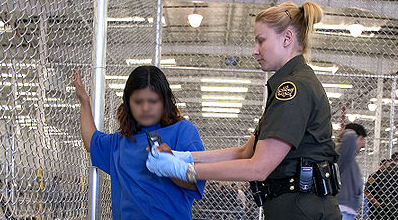
The photograph featured at the top of this post is of a Customs and Border Patrol agent conducting a patdown of a Mexican girl being detained. Courtesy of the US government.

Martin Luther King Jr and Open Borders

Since I believe one of the best strategies for the opening of the world’s borders is to cast it as a civil rights issue, I thought it would be a good idea to go back to some of the classical rhetorical pieces of the American Civil Rights Movement and read them in the light of free migration. There is one readily apparent similarity between racial segregation and immigration restrictions. Racial segregation limits the mobility of certain persons on the morally arbitrary basis of the color of their skin, and this is done regardless of whether people on the “other side” of the segregation are willing to interact peacefully. A closed border restricts mobility and voluntary, peaceful interaction on the morally arbitrary basis of which side of the border a person happened to be born on.

The work and rhetoric of Martin Luther King Jr seems like the obvious place to begin. In April 1963, King organized marches and sit-ins of public spaces in Birmingham, Alabama, intentionally violating the segregation laws of the time that proscribed blacks from sharing certain public and private spaces with whites. King was arrested and jailed, and from his cell he wrote what became known as his Letter from a Birmingham Jail. In the letter King responds to critics who have urged him to pursue his goals of racial equality with patience and through legal channels, rather than violating the laws of the land. There is already a parallel here to the demands of immigration restrictionists that aspiring migrants “wait in line” despite the fact that there is no real “line” for many migrants.

King begins his letter defending himself against charges of being an “outside agitator” stirring up trouble in a place where he isn’t welcome. The following doesn’t really relate to open borders in an obvious way, but it’s a beautiful statement of the kind of cosmopolitanism that underpins the call to open borders.

Moreover, I am cognizant of the interrelatedness of all communities and states. I cannot sit idly by in Atlanta and not be concerned about what happens in Birmingham. Injustice anywhere is a threat to justice everywhere. We are caught in an inescapable network of mutuality, tied in a single garment of destiny. Whatever affects one directly, affects all indirectly. Never again can we afford to live with the narrow, provincial “outside agitator” idea. Anyone who lives inside the United States can never be considered an outsider anywhere within its bounds.

He moves on to defend the timing of his nonviolent activism and his decision to act directly rather than wait for political negotiations to bear fruit.

You may well ask: “Why direct action? Why sit ins, marches and so forth? Isn’t negotiation a better path?” You are quite right in calling for negotiation. Indeed, this is the very purpose of direct action. Nonviolent direct action seeks to create such a crisis and foster such a tension that a community which has constantly refused to negotiate is forced to confront the issue. It seeks so to dramatize the issue that it can no longer be ignored. My citing the creation of tension as part of the work of the nonviolent resister may sound rather shocking. But I must confess that I am not afraid of the word “tension.” I have earnestly opposed violent tension, but there is a type of constructive, nonviolent tension which is necessary for growth. Just as Socrates felt that it was necessary to create a tension in the mind so that individuals could rise from the bondage of myths and half truths to the unfettered realm of creative analysis and objective appraisal, so must we see the need for nonviolent gadflies to create the kind of tension in society that will help men rise from the dark depths of prejudice and racism to the majestic heights of understanding and brotherhood. The purpose of our direct action program is to create a situation so crisis packed that it will inevitably open the door to negotiation. I therefore concur with you in your call for negotiation. Too long has our beloved Southland been bogged down in a tragic effort to live in monologue rather than dialogue.

The connection I’d like to draw here is that aspiring migrants who are scared or otherwise hesitant to migrate through unofficial channels have no political voice with which to negotiate for their rights to enter the land of their choosing. Migrants who are willing to brave the move without legal authorization of the host country gain no political voice by doing so, but by acting directly, seizing their rights in spite of the law, they raise the probability of reform just by virtue of their presence. Without the legal tension created by the presence of illegal immigrants, there would likely never be any movement toward opening borders, regardless of how powerful the arguments for open borders might be. Such arguments would be hopelessly academic.

My friends, I must say to you that we have not made a single gain in civil rights without determined legal and nonviolent pressure. Lamentably, it is an historical fact that privileged groups seldom give up their privileges voluntarily. Individuals may see the moral light and voluntarily give up their unjust posture; but, as Reinhold Niebuhr has reminded us, groups tend to be more immoral than individuals.

We know through painful experience that freedom is never voluntarily given by the oppressor; it must be demanded by the oppressed. Frankly, I have yet to engage in a direct action campaign that was “well timed” in the view of those who have not suffered unduly from the disease of segregation. For years now I have heard the word “Wait!” It rings in the ear of every Negro with piercing familiarity. This “Wait” has almost always meant “Never.” We must come to see, with one of our distinguished jurists, that “justice too long delayed is justice denied.”

For years now we have heard the words “Wait in line!” It rings in the ear of every migrant with piercing familiarity. This “Wait in line” has almost always meant “Never.”

We have waited for more than 340 years for our constitutional and God given rights. The nations of Asia and Africa are moving with jetlike speed toward gaining political independence, but we still creep at horse and buggy pace toward gaining a cup of coffee at a lunch counter. Perhaps it is easy for those who have never felt the stinging darts of segregation to say, “Wait.” But when you have seen vicious mobs lynch your mothers and fathers at will and drown your sisters and brothers at whim; when you have seen hate filled policemen curse, kick and even kill your black brothers and sisters; when you see the vast majority of your twenty million Negro brothers smothering in an airtight cage of poverty in the midst of an affluent society; when you suddenly find your tongue twisted and your speech stammering as you seek to explain to your six year old daughter why she can’t go to the public amusement park that has just been advertised on television, and see tears welling up in her eyes when she is told that Funtown is closed to colored children, and see ominous clouds of inferiority beginning to form in her little mental sky, and see her beginning to distort her personality by developing an unconscious bitterness toward white people; when you have to concoct an answer for a five year old son who is asking: “Daddy, why do white people treat colored people so mean?”; when you take a cross county drive and find it necessary to sleep night after night in the uncomfortable corners of your automobile because no motel will accept you; when you are humiliated day in and day out by nagging signs reading “white” and “colored”; when your first name becomes “nigger,” your middle name becomes “boy” (however old you are) and your last name becomes “John,” and your wife and mother are never given the respected title “Mrs.”; when you are harried by day and haunted by night by the fact that you are a Negro, living constantly at tiptoe stance, never quite knowing what to expect next, and are plagued with inner fears and outer resentments; when you are forever fighting a degenerating sense of “nobodiness”–then you will understand why we find it difficult to wait. There comes a time when the cup of endurance runs over, and men are no longer willing to be plunged into the abyss of despair. I hope, sirs, you can understand our legitimate and unavoidable impatience.

One of the most powerful paragraphs in the letter. When I read this I thought of the environment of uncertainty in which immigrants in the US live, especially in places like Joe Arpaio’s Arizona, where immigrants and suspected immigrants have suffered popularly lauded degradations like forced marches in pink underwear, meals of moldy bread and rotten fruit, and childbirth given in shackles. While in the rest of America, undocumented immigrants live constantly at tiptoe stance, lest some traffic violation result in their deportation following indefinite detention in a jail cell. And this is all for the equivalent of a cup of coffee at the lunch counter: the right to live and work peacefully among those born within the border.

Meanwhile millions of our brothers and sisters in the undeveloped world smother in an airtight cage of poverty in the midst of the affluent societies of the developed world, their tongues twisted and speech stammering, explaining to their children why they can’t move to the places where work is plentiful, water is clean, and wages are high.

You express a great deal of anxiety over our willingness to break laws. This is certainly a legitimate concern. Since we so diligently urge people to obey the Supreme Court’s decision of 1954 outlawing segregation in the public schools, at first glance it may seem rather paradoxical for us consciously to break laws. One may well ask: “How can you advocate breaking some laws and obeying others?” The answer lies in the fact that there are two types of laws: just and unjust. I would be the first to advocate obeying just laws. One has not only a legal but a moral responsibility to obey just laws. Conversely, one has a moral responsibility to disobey unjust laws. I would agree with St. Augustine that “an unjust law is no law at all.”

Now, what is the difference between the two? How does one determine whether a law is just or unjust? A just law is a man made code that squares with the moral law or the law of God. An unjust law is a code that is out of harmony with the moral law. To put it in the terms of St. Thomas Aquinas: An unjust law is a human law that is not rooted in eternal law and natural law. Any law that uplifts human personality is just. Any law that degrades human personality is unjust. All segregation statutes are unjust because segregation distorts the soul and damages the personality. It gives the segregator a false sense of superiority and the segregated a false sense of inferiority.

The last line speaks to one of the less savory arguments against open borders: that the global poor suffer their lots because they are less intelligent or lack the work ethic of the citizens of the rich world or some other failing. After more discussion of the differences between just and unjust laws, King sets up one of his chief foils: the white moderate.

[I] must confess that over the past few years I have been gravely disappointed with the white moderate. I have almost reached the regrettable conclusion that the Negro’s great stumbling block in his stride toward freedom is not the White Citizen’s Counciler or the Ku Klux Klanner, but the white moderate, who is more devoted to “order” than to justice; who prefers a negative peace which is the absence of tension to a positive peace which is the presence of justice; who constantly says: “I agree with you in the goal you seek, but I cannot agree with your methods of direct action”; who paternalistically believes he can set the timetable for another man’s freedom; who lives by a mythical concept of time and who constantly advises the Negro to wait for a “more convenient season.” Shallow understanding from people of good will is more frustrating than absolute misunderstanding from people of ill will. Lukewarm acceptance is much more bewildering than outright rejection.

I had hoped that the white moderate would understand that law and order exist for the purpose of establishing justice and that when they fail in this purpose they become the dangerously structured dams that block the flow of social progress. I had hoped that the white moderate would understand that the present tension in the South is a necessary phase of the transition from an obnoxious negative peace, in which the Negro passively accepted his unjust plight, to a substantive and positive peace, in which all men will respect the dignity and worth of human personality. Actually, we who engage in nonviolent direct action are not the creators of tension. We merely bring to the surface the hidden tension that is already alive. We bring it out in the open, where it can be seen and dealt with. Like a boil that can never be cured so long as it is covered up but must be opened with all its ugliness to the natural medicines of air and light, injustice must be exposed, with all the tension its exposure creates, to the light of human conscience and the air of national opinion before it can be cured.

It isn’t the racists or the committed nativists and nationalists who are the biggest roadblocks in the way of open borders. We will never win them over and it’s barely worth the effort of trying beyond countering their arguments for the benefit of observers. The great roadblock consists of basically sympathetic people who are nonetheless wary of the apparent radicalism of open borders; or people who simply do not realize the scale of humanitarian benefits on the table; or those who have no problem with immigrants personally, but assume that immigration must be zero-sum, with jobs gained by foreigners equaling jobs lost to natives.

The point of this post is not to twist Dr King’s eloquence to favor open borders. I have no idea if he believed in open borders or if he gave the matter much thought either way. The point is to take the words of this celebrated moral leader and use them to show how the civil rights for which he struggled parallel the rights of international immigration. At root, these rights are expressions of the universal moral equality of human beings. King’s sphere of concern certainly extended beyond African-Americans and far beyond America’s national borders. In a speech against US involvement in the Vietnam War, he made this call to cosmopolitan compassion:

This I believe to be the privilege and the burden of all of us who deem ourselves bound by allegiances and loyalties which are broader and deeper than nationalism and which go beyond our nation’s self-defined goals and positions. We are called to speak for the weak, for the voiceless, for the victims of our nation and for those it calls “enemy,” for no document from human hands can make these humans any less our brothers.


 

CBO Dynamically Scores Immigration Bill

This post was originally published on the Cato-at-Liberty blog here and is republished with the permission of the author.

The Congressional Budget Office has fiscally scored the Senate’s immigration bill, S. 744, and found that it will decrease fiscal deficits over the next 20 years—giving a huge boost to reform proponents.  In line with criticisms made by me and others, the CBO departed from orthodoxy and assumed that S. 744 would affect economic growth (i.e., they dynamically scored the bill)—arguing that the economic and fiscal gains from immigration reform are clear.  These findings are broadly consistent with Cato’s findings here.

The CBO produced two scores of S. 744.  The first was less dynamic, assuming that GDP and the workforce would grow as a result of immigration. Increased numbers of workers will add to GDP, producing growth by definition, and not displacing many other workers.  The second score is more dynamic, taking into account many of the economic effects of immigration reform using an enhanced Solow model.

The less-dynamic CBO score found that immigration reform will reduce the federal deficit by about $197 billion by increased GDP and tax revenues through adding six million people to the workforce by 2023.  Over a period of 20 years, the CBO estimated that this legislation would reduce deficits by about $700 billion—a sizeable decrease.  In what seems to be a specific dig at the 50-year span of the recent Heritage study, the CBO wrote that, “we cannot determine whether enactment of S. 744 would lead to an increase in on-budget deficits … in any of the three 10-year periods starting in 2033.”

The more dynamic CBO score found that S. 744 would not affect the budget by 2023.  However, because the dynamic economic effects of S. 744 would affect the economy slowly, the CBO predicts a $300 billion decrease in deficits from 2023-2033 greater that the $700 billion reported in the less-dynamic score.

The more-dynamic CBO model predicts $1.197 trillion in reduced deficits over the next 20 years if immigration reform is passed.

Delving into the details of the CBO’s more-dynamic score, they estimated that S. 744 would increase GDP by 3.3 percent in 2023 and 5.4 percent in 2033, relative to the baseline.  Per capita GNP would lower by .7 percent by 2023 but be higher by .2 percent in 2033.  Wages would be .5 percent higher in 2033 under S. 744.

The more-dynamic score takes into account these effects from S. 744:

  1. Increased size and employment in the economy.
  2. Increased average wages after 2025.
  3. Slightly increased unemployment rate through 2020.
  4. Increased quantity of capital investment.
  5. Increased productivity of labor (due to complementary task specialization).
  6. Increased productivity of capital (due to increase in supply of labor and TFP).
  7. Higher interest rates.

The CBO took account of some of the main findings in the economic literature about the economic effects of immigration.  For example, the CBO predicts there will be a 12 percent increase in the wages of legalized immigrants.

Conceptually, dynamically scoring legislation is a big step toward rationally judging the costs and benefits of policy changes.  Legislation that changes the size of the economy or the pace of economic growth will affect future tax revenues that will, in turn, affect the fiscal state of the federal government.  CBO scores have been inaccurate over time—many wildly so.  They should never be the final word on the estimated net fiscal costs of immigration reform, but this is the most thorough examination to date. The CBO’s findings broadly confirm Cato’s research that immigration reform will be economically beneficial to immigrants and the country as a whole.