
Hospitality in The Odyssey

Restrictionists frequently try to marginalize the arguments of open borders by claiming that, as Steve Camarota put it in our TV debate, “all societies, all sovereign states throughout all history have always had the idea that they can regulate who comes into their society,” or more generally, by treating state sovereignty as a universal norm of human life and migration restrictions as an essential element of sovereignty. In fact, passport controls were the exception rather than the rule until the early 20th century, and as far as I have been able to judge the evidence (but more research would be useful), there is little by way of analogous institutions in former times. What there is evidence for is a norm of hospitality across many cultures.

In particular, hospitality is perhaps the foremost moral theme of The Odyssey, one of the two great epics of ancient Greece. It was written (according to tradition) by Homer, who was also the author of the other great Greek epic, The Iliad. The Odyssey and the Iliad were to the Greeks a little like the Bible to the Jews: major source books of ethics, theology, and history; central reference points for the culture; definers of the Greek identity. The great difference in character between the Greek epics and the Bible expresses very well the great difference in character between the Greeks and the Jews. I previously wrote about the immigration policy encoded in the Mosaic law of the Old Testament. Having formed my open borders views, and even written a book about it, long before I studied the Old Testament teachings on the treatment of the foreigner, I was amazed at the extent to which the Bible confirmed my views, if indeed it does not go even farther than I had dared to go in insisting that strangers be welcomed and well-treated. In its own, quite different way, yet hardly less emphatically, the Odyssey, too, gives open borders supporters all they could ask for.

Odysseus, the hero and namesake of the Odyssey, is a Greek king from the heroic age, who participated in the great war that ended in the destruction of Troy. That war originated in the pollution of hospitality by Paris, the Trojan prince who was a guest of Spartan king Menelaus and seduced his wife Helen. Hospitality is a two-way street. Guests as well as hosts have obligations. On his return voyage, however, Odysseus runs into all sorts of troubles and disasters that keep him from getting home. The epic begins about twenty years after the fall of Troy, by which time Odysseus’s house has been overrun by men– “the suitors”– who are wasting his goods and seeking to marry his wife. The suitors, those unwelcome guests, are the villains of the epic, who in the climax of the story are slaughtered by the returning Odysseus. Again, hospitality is a two-way street, but it would be a stretch to compare the suitors to illegal immigrants, for it is not their mere presence in the household, but their theft of Odysseus’s goods and their hopes of marrying Odysseus’s wife that seem to make them the villains. Worse, at one point they plot to murder Odysseus’s son. Moreover, when Odysseus returns in the guise of a wandering beggar, they treat him with great inhospitality. Thus they deserve their fate.

Meanwhile, Odysseus is a love-slave on the island of the goddess, Calypso, but in spite of her divine embraces, yearns to return home. At last, the gods grant him to sail to the country of a people called the Phaecians, where they know, but Odysseus does not, that he will be well-treated and given passage back to his home country of Ithaca. After a rough sea voyage he is wrecked on the Phaecian coast, where he says (this is in Book VI):

“Alas,” said he to himself, “what kind of people have I come amongst? Are they cruel, savage, and uncivilized, or hospitable and humane? I seem to hear the voices of young women, and they sound like those of the nymphs that haunt mountain tops, or springs of rivers and meadows of green grass. At any rate I am among a race of men and women. Let me try if I cannot manage to get a look at them.”

Note the dichotomy Odysseus makes here. A people may be (a) cruel, savage, and uncivilized, or (b) hospitable and humane. Hospitality, humane treatment of guests, is the first, defining feature of civilized peoples. Of course, it might only be uppermost in Odysseus’s mind because he will soon be obliged to seek their hospitality. Still, the identification of hospitality with civilization shows the importance of this norm.

Shortly afterwards, Odysseus (known to the Latins as Ulysses) finds himself in the court of King Alcinous of the Phaecians, where (in Book VII) he presents himself as a suppliant:

So here Ulysses stood for a while and looked about him, but when he had looked long enough he crossed the threshold and went within the precincts of the house… Every one was speechless with surprise at seeing a man there, but Ulysses began at once with his petition.

“Queen Arete,” he exclaimed, “daughter of great Rhexenor, in my distress I humbly pray you, as also your husband and these your guests (whom may heaven prosper with long life and happiness, and may they leave their possessions to their children, and all the honours conferred upon them by the state) to help me home to my own country as soon as possible; for I have been long in trouble and away from my friends.”

Then he sat down on the hearth among the ashes and they all held their peace, till presently the old hero Echeneus, who was an excellent speaker and an elder among the Phaeacians, plainly and in all honesty addressed them thus: “Alcinous,” said he, “it is not creditable to you that a stranger should be seen sitting among the ashes of your hearth; every one is waiting to hear what you are about to say; tell him, then, to rise and take a seat on a stool inlaid with silver, and bid your servants mix some wine and water that we may make a drink-offering to Jove the lord of thunder, who takes all well-disposed suppliants under his protection; and let the housekeeper give him some supper, of whatever there may be in the house.”

When Alcinous heard this he took Ulysses by the hand, raised him from the hearth, and bade him take the seat of Laodamas, who had been sitting beside him, and was his favourite son. A maid servant then brought him water in a beautiful golden ewer and poured it into a silver basin for him to wash his hands, and she drew a clean table beside him; an upper servant brought him bread and offered him many good things of what there was in the house, and Ulysses ate and drank. Then Alcinous said to one of the servants, “Pontonous, mix a cup of wine and hand it round that we may make drink-offerings to Jove the lord of thunder, who is the protector of all well-disposed suppliants.”

In this passage, it is clear that King Alcinous has some authority to decide who will be received in his hall, though it does not follow that he gets to decide who is present on the territory of his kingdom. But the king is not exactly at liberty to exercise this authority simply as he happens to prefer. Echeneus, who is characterized as an “old hero,” suggesting an exemplar of virtue, declares that it is “not creditable” to treat “a stranger” otherwise than to welcome him by giving him an honorable seat. Moreover, there is a theological justification for this: “Jove [Zeus] takes all well-disposed suppliants under his protection.” Here there is a striking parallel with the Old Testament, where it is written that God “defends the cause of the fatherless and the widow, and loves the foreigner residing among you, giving them food and clothing” (Deuteronomy 10:18). Clearly, Echeneus is not making this up, but rather expressing the conventional wisdom, “speaking plainly and in all honesty,” and the king quickly echoes him, saying that “Jove [Zeus] the lord of thunder… is the protector of all well-disposed suppliants.” Continue reading Hospitality in The Odyssey
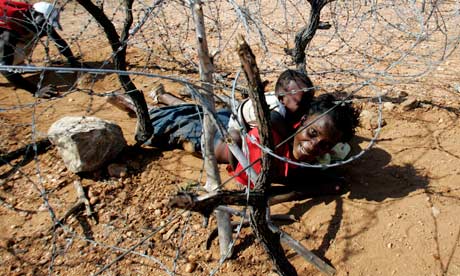
Risking death to get into South Africa

The supposedly horrible socioeconomic consequences of South African apartheid’s abolition are sometimes used as a cautionary tale against open borders. But this story of Ethiopians and Somalians risking life and limb to get into South Africa serve as a potent example of how much people are willing to risk in search of a better life:

41 young Ethiopians suffocated to death inside an overcrowded van in Tanzania. With the aid of human traffickers, they had been hoping to start a new life in South Africa.

Some ended up paying with their lives, while those who survived will be deported back to their home country.

…Most refugees from Ethiopia and Somalia are economic refugees, says Getachew. But others flee also from war and political persecution. 32 year-old Mohad Abdul is among those who fled to South Africa because of violence in Somalia….Integration in South Africa was relatively easy for Abdul. He quickly obtained a residence and work permit. Today he is a businessman in Johannesburg and watches closely as more and more Somalis and Ethiopians flock into the country.

In no other country are there so many asylum applications. In 2011 alone, there were 100,000 applications. The authorities can scarcely keep up with processing them.

There is no accounting for such reckless risking of life without considering the place premium: the same person doing the same job in one country can earn dramatically more than he or she would in a different country. The Somalian fleeing lawlessness is almost certain to be more productive in any other society in the world, since that country will at least have a half-functioning legal system. It is not difficult to imagine that even countries in less anarchic states might not offer their citizens the institutions conducive to productivity and prosperity which do exist a country or two away.

The international wage discrimination created by closed borders is literally the worst that has ever been measured. That conclusion may sound shockingly strong, but when you consider that there are Indonesians who literally migrate to Australian jails (because to them it’s better to be in a jail in Australia than free in their homeland) or Afghans who risk being shot to death to get into Iran, what’s shocking is how blind we are to the suffering which closed borders create.

The image featured at the top of this post is of a mother with her child crawling under the South African fence bordering Zimbabwe, taken by Themba Hadebe for the Associated Press in 2010 and published in The Guardian.

The Scramble for Africa, fractionalization and open borders

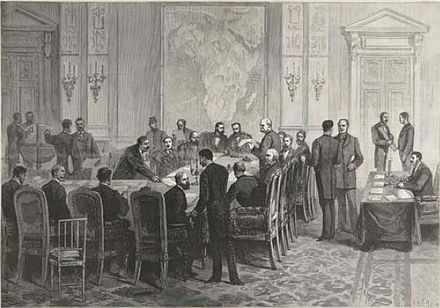
Co-blogger Nathan Smith’s plea for someone to write a history of borders got me thinking about Africa and how its borders were drawn. The Berlin Conference of 1884-85 formalized what has come to be known as the “Scramble for Africa“, a process through which contemporary African borders were drawn. And as many researchers have shown, Africa’s borders were largely drawn in an arbitrary manner with little regard for the interests of the people who would later fall under the jurisdiction of those same borders. Michalopoulos and Papaioannou summarize the Scramble for Africa thus [footnotes omitted and my own emphasis]:

The key consideration of European leaders [in drawing up Africa’s borders] was to preserve the “status quo” preventing conflict among Europeans for Africa (as the memories of the European wars of the 18th-19th century were still alive). To this objective the Europeans divided areas and drew borders in maps, without taking into account local conditions and the ethnic composition of the areas. African leaders were not invited and had no say on the drawing of political boundaries. Moreover, European leaders were in such a rush that they didn’t wait for the new information arriving from explorers, geographers, and missionaries.

There is little disagreement among historians that the scramble for the continent was to a great extent artificial (see Asiwaju (1985) and Englebert (2009) for references). As the British prime minister at the time Lord Salisbury put it, “we have been engaged in drawing lines upon maps where no white man’s feet have ever tord; we have been giving away mountains and rivers and lakes to each other, only hindered by the small impediment that we never knew exactly where the mountains and rivers and lakes were.” Asiwaju (1985) summarizes that “the study of European archives supports the accidental rather than a conspiratorial theory of the marking of African boundaries.” In line with the historical evidence, Alesina, Easterly, and Matuszeski (2011) document that eighty percent of African borders follow latitudinal and longitudinal lines, more than in any other part of the world.

A direct effect of the Scramble for Africa was the partitioning of ethnic groups, many of which had existed as unitary “nation-states” for many of years. Michalopoulos and Papaioannou quantify this partitioning effect thus:

 Quantifying the effects of the Scramble for Africa requires identifying the partitioned groups. To do so we use anthropological data from the pioneering work of George Peter Murdock (1959), who has mapped the spatial distribution of 834 ethnicities at the time of colonisation in the mid/late 19th century. [We] classify as partitioned groups those ethnicities with at least 10% of their total surface area belonging to more than one country. There are 231 ethnic groups with at least 10% of their historical homeland falling into more than one country. When we use a more restrictive threshold of 20% there are 164 ethnicities partitioned across the national border.

Our procedure identifies most major partitioned ethnic groups. For example, the Maasai have been split between Kenya (62%) and Tanzania (38%), the Anyi between Ghana (58%) and the Ivory Coast (42%), and the Chewa between Mozambique (50%), Malawi (34%), and Zimbabwe (16%).  We also calculate the probability that a randomly chosen pixel of the homeland of an ethnic group falls into different countries. The ethnic groups with the highest score in this index are the Malinke, which are split into six different countries; the Ndembu, which are split between Angola, Zaire, and Zambia; and the Nukwe, which are split between Angola, Namibia, Zambia, and Botswana.

Another direct effect of the Scramble for Africa was the mishmash of different ethnic groups under a single border. The degree of such mishmash can be quantified by calculating an ethnic fractionalization index for a country, with the index ranging from zero to one. An index closer to one implies that a particular country is very ethnically diverse in the sense that the probability that two randomly picked individuals belong to the same ethnic group is very low. Using the indices calculated by Alesina et al., the average ethnic fractionalization index for sub-Saharan Africa is 0.65 with a median of 0.73. On the other hand, the average for Western Europe is 0.20 with a median of 0.12. The top 5 African countries with the highest indices are Uganda (0.93), Liberia (0.91), Madagascar (0.88), Congo DR (0.87) and the Republic of Congo (0.87). In Western Europe’s case the top 5 are Belgium (0.56), Switzerland (0.53), Luxembourg (0.53), Spain (0.42) and Germany (0.17). If the top 5 European countries were in Africa, they would rank 37th, 38th,39th, 42nd and 51st respectively in terms of ethnic fractionalization. The fact that Western European countries are not as ethnically diverse as African countries should not be surprising. The process of nation-state formation was more systematic in Western Europe with the result that the nation-state formed around less ethnically heterogeneous groups.

The effects of Africa’s arbitrary border formation have not been benign, as one would expect. In a now famous scholarly article from 1997, Easterly and Levine showed that Africa’s dismal post-independence economic performance was largely driven by the high degree of ethnic fractionalization. The authors showed that “ethnic [fractionalization] was closely associated with low schooling, underdeveloped financial systems, distorted foreign exchange markets, and insufficient infrastructure”. And this was driven by the fact that “[ethnic fractionalization] leads to rent-seeking behavior and reduces the consensus for public goods, creating long-run growth tragedies” (my italics). Even more tragic, recent work by Michalopoulos and Papaioannou shows that the random partitioning of ethnic groups explains much of the continent’s civil wars since the 1960s. Their work shows that “civil conflict intensity, as reflected in casualties and duration, is approximately 25% higher in areas where partitioned ethnicities reside (as compared to the homelands of ethnicities that have not been separated)”. The groups that have been particularly impacted by this are “the Afar and the Esa, which during the period from 1970 to 2005 have experienced five civil wars…[T]he Afar being partitioned between Ethiopia, Eritrea and Djibouti, and the Esa being split between Ethiopia and Somalia”. And the effects are not only limited to partitioned ethnic groups: “Tribal areas adjacent to the ethnic homeland of partitioned groups also experience more civil wars, which tend to last longer and be more devastating. [E]stimates imply that an ethnic group residing adjacent to a partitioned ethnic homeland is on average 5% more likely to experience civil conflict”. And civil conflicts have led to the death of millions of people in Africa and to the displacement of many more.

One can easily imagine that a different border configuration that, for instance took into account the historical interests of different ethnic groups, might have kept at a minimum some of the problems highlighted in the previous paragraph. And this is why I believe that global open borders can go a long way in rectifying some of the consequences of the Scramble for Africa. Under open borders, individuals belonging to certain ethnic groups or entire ethnic groups can easily relocate to countries that the individual or the ethnic group indentifies with or to countries that are likely to guarantee the safety of the individual or his group. (In this post, I showed that the fact that the US has open borders between states made it easier for targetted ethnic/racial groups to migrate elsewhere). Currently the costs of emigrating, even within Africa, are substantial. Very often those on the receiving end of ethnic conflicts are not allowed to easily intergrate into the neighbouring countries to which they run to but are instead placed in refugee camps known for their notoriety. Similarly, those individuals or groups seeking a better life economically in a neighbouring country are required to obtain a dossier of documents, most of which are costly to obtain, before crossing the border to begin the employment search. Those who are unable to obtain these documents resort to risky methods to get themselves across (Update: for more on this last point, see John Lee’s post titled Risking death to get into South Africa).

Some might object that whereas global open borders might lead to a reduction in ethnic diversity in Africa, for instance, they might, on the other hand, lead to an increase in ethnic diversity in certain parts of the developed world such as Western Europe or the United States. And with ethnic diversity increasing, the very problems that open borders were meant to correct in Africa might crop up in the West. This fear, however, is not borne out by research. An exhaustive literature survey by Alesina and La Ferrara finds that “rich democratic societies work well with [ethnic] diversity, in the case of the United States very well interms of growth and productivity”. This result seems to run through institutions. The presently developed countries are developed largely because their initially homogeneous populations built a consensus around establishing a set of inclusive institutions. (It is this process of consensus building that was likely short-circuited in Africa’s case during the Scramble for Africa). And these institutions are unlikely to change in the face of increased diversity because institutions, once established, tend to persist. And it goes without saying that the types of individuals or types of ethnic groups that are likely to relocate to the West are the kinds of individuals or kinds of ethnic groups that identify with the West’s way of life, including its institutions.

UPDATE: Co-bloggers Vipul Naik and Nathan Smith have previously addressed, in some great detail, the relationship between immigration, immigrants and institutions here, here and here.

Related reading

Germany is thinking about abolishing visas

Open borders advocates may have some allies over in Germany. In January this year, Deutsche Welle published this story with the unassuming title German companies want fewer visa restrictions (emphasis added):

Visa applications take too long, representatives from German industry say. They argue that companies lose money when a foreign business partner cannot travel. And they have concrete proposals to reform the system.

A deal worth millions was almost closed at a German agricultural fair, but urgently needed visas could not be issued to the foreign business partner. The telephone number in the documents was wrong, so embassy officials couldn’t reach anyone.

This is not a unique case, according to Andreas Metz, a spokesman for the German business community’s Committee on Eastern European Economic Relations. He cannot understand why old rules are followed to the word.

The visa system is actually a relic of the 19th century,” Metz told DW. “Today, there is a completely different method to ensure security, namely through a biometric passport and computerized information, which impede travel less significantly.” He hopes that visa requirements will be done away with eventually.

The discussion about unrestricted travel is also being discussed at the government level. German Economics Minister Philipp Rösler is pushing for more freedom. He recently called for Interior Minister Hans-Peter Friedrich to give up his opposition to a more liberal issuing of visas.

The Interior Ministry’s main argument is security. The ministry is in favor of simplifying the visa application procedure, but it is against getting rid of visas. It has to ensure that aspects related to security and migration policy are preserved, the ministry said.

It seems difficult to believe that the German government is considering open borders via the abolition of visas. I’m not sure what exactly is being meant here by abolishing visas, since I can’t imagine the German government is eager to invite the entire world to live in its borders. (The article goes on to cite concerns about Turks and Russians unlawfully settling in Germany if visas are abolished.) Probably what’s being envisioned is that visitors would not require visas, so anyone can enter — but settling would still require a residency permit.

(By the way, talking of political externalities — Philipp Rösler is an immigrant from Vietnam who was adopted by a German family, so one can argue he has something of a vested interest in loosening border controls.)

This isn’t true open borders, but it’s one way to start down the road there. As the German lobbyist indicates, the modern visa system is only going to become even more out of place with the advancement of technology. I can still envision scenarios where a reasonable government would require visas: I can see the case for requiring visas from countries which are hotbeds for terrorism or organised crime. But modern technology makes the case for abolishing visas only more compelling.

Zen and the Art of Opening Borders

One of the biggest challenges in trying to present the case for open borders to those who don’t agree is choosing the right mix of logic, evidence, and appeal to emotion. When people talk about the moral case for open borders, it often seems that what they are referring to is moral logic. That is, they are discussing the logical consequences of certain moral propositions.

In my experience, people are usually not convinced by logic. While they might tend to agree with a statement like “we should not discriminate based on arbitrary factors over which people have no control”, if you extend that principle to conclude that they should afford non-citizens the exact same treatment as citizens they will feel trapped by the logic and seek to find a way out. The logic didn’t address all of their concerns, so it feels like a trick.

However, I do think logic plays a major role in understanding how people feel, and in trying to frame arguments in a way that will make sense to them. With that in mind, here is my candidate for an argument in favor of open borders that attempts to balance these concerns:

Proposition 1: As Americans (or citizens of another wealthy western nation) we benefit from a valuable cultural and institutional heritage.

Proposition 2: We have a duty both to protect this heritage and to share it with as many people as we can.

Proposition 3: One of the most best ways to share our heritage with others is to allow them to live and work within our national borders.

This line of argument explicitly acknowledges the importance national identity. Most Americans identify as Americans, and they think that means something special. I agree.

It also acknowledges that we have a duty to protect our heritage. This means that we need to take seriously the question of whether allowing too many immigrants into the country will undermine what makes the country special. It is okay to admit that at some point, enough unrestricted immigration can have negative consequences. I personally think that the optimal level is probably an order of magnitude or so higher than what we currently have, but trying to protect our national culture and institutions is a legitimate concern.

Finally, the argument puts open borders in a category of other useful things that we can do to share our heritage that a lot of other people agree with, such as providing support for emerging democracies and encouraging forms of economic integration that allow people from poor countries to participate in our economy without moving here. (I am a big fan of the web based work sourcing site Odesk. Look it up if you haven’t heard of it.)

What this argument does not do is try to gain a lot of ground by reasoning about whether we have a right to close our borders, or whether closing them should be considered refusing to help or actively doing harm.  These are interesting philosophical questions, but I don’t think they are effective for making public arguments.

The three propositions are quite general, and there are many details to be specified. For example, what exactly is it about our heritage that is so valuable? In some cases we can measure the impact of institutional differences. For example, there is evidence that countries with a legal system that developed based on English common law experience faster economic growth. Other aspects of our culture are not so easily quantified. How valuable is the widespread expectation that the government will not censor the media?

Another important question is once we accept that we need to protect our national heritage what is the best way to do it? Does it require limiting the number of immigrants to a certain quota? If every citizen were instantly replaced by someone from a different cultural background, our heritage would probably be lost. But this is not really how immigration works. When large numbers of immigrants enter the country it takes time before they begin to occupy the most culturally influential positions in society. That is, our judges, journalists, teachers, congressmen, and artists would be largely the same until the new groups began to assimilate

So I personally don’t think  a quota would be necessary if we implemented some of the keyhole solutions discussed here. A student of mine whose family entered the country illegally from Mexico claims that a good coyote can cost up to $25,000 per head these days (Although the average cost is probably much lower). Charging each immigrant a one time fee of $10,000-$20,000 would spare them the risks associated with crossing illegally and mitigate any strain strain they place on the education and welfare systems. It would also create a more flexible constraint on the number of immigrants that enter the country.

These propositions are not meant to specify a certain policy , but rather as a rhetorical framework for discussing the issues. They are meant as a way to put the arguments for open borders in language that makes more sense to people outside the open borders community. I would be very interested to know whether other advocates of open borders find them acceptable.