
Migration and Christianity

When I wrote Principles of a Free Society, I hinted at a Christian case for open borders:

American Christianity has not been only a conservative force, fending off bad foreign ideas and keeping America true to its heritage of freedom. It has often championed reform, progressively realizing the latent imperatives of America’s founding ideals.

Nobel laureate Robert Fogel has argued that American history has followed a pattern by which the evolution of religion leads the evolution of political reform, with four “Great Awakenings” in religion– in 1730-60, 1800-40, 1890-1930, and 1960 to around 1990– leading to four great eras of political reform: the American revolution, the anti-slavery movement and the Civil War, the creation of the welfare state, and the civil rights movement; and finally the tax revolt of the Reagan era and the 1996 welfare reform.

Fogel’s periodization could be disputed; but the links he draws between religion and political reform are compelling. Churches enjoy no institutional representation in the American political system, nor do they typically instruct their members how to vote. Yet religion heavily influences voting behavior and other forms of political participation. Today, for example, one of the strongest predictors of voting Republican is church attendance.

In spite of the Republican bias of American Christians, however, and the anti-immigration bias of the Republican Party, I think there are signs that immigration (that is, support for immigration) is emerging as a distinctively Christian political issue. An immigration amnesty in 1986 was championed and signed by a born-again Christian president, Ronald Reagan. Another Christian president, George W. Bush, strove for and nearly succeeded in passing immigration reform in 2006 and 2007, with widespread support from churches.

The Catholic Cardinal Mahoney of Los Angeles compared a repressive anti-immigration law in Arizona to Nazism. Richard Land, president of the general conservative Southern Baptist Convention’s Ethics and Religious Liberty Commission, has advocated comprehensive immigration reform. Polls by Pew show that religious leaders and frequent churchgoers are significantly more pro-immigration than less frequent attenders.

Ultimately, I think the Bible, the New Testament, the Parable of the Good Samaritan, and in particular one detail in the Parable of the Good Samaritan, will force Christians to turn against the world apartheid system of border controls. When the priest and the Levite see the wounded man on the road to Jericho, they do not just fail to help, they pass by on the other side of the road— that is, they deliberately create physical distance between themselves and the suffering man in order to avoid incurring the moral responsibility to help him.

But of course, this is exactly what migration restrictions do: they keep the world’s poor at a distance, so that we will not feel conscience-stricken and have to help them. But of course it is perfectly clear in the parable that the priest and the Levite only make themselves more culpable by trying to avoid moral responsibility; and so it is with rich countries that close their borders to poor immigrants. Christians cannot go on failing to see this indefinitely. Time for a Fifth Great Awakening?…

How would church-state relations change if the conviction became widespread among Christians that to “love thy neighbor” meant not collaborating with the enemies who want to deport him? (Principles of a Free Society, pp. 189-191)

At that time, however, I had not read what the Old Testament specifically has to say about immigrants. When I did so, last May, for the post “The Old Testament on Immigration,” I was astonished at how thoroughly they confirmed my views. Again and again, the Bible stresses that foreigners are to be given justice, treated fairly, loved, and included in Jewish festivals and Sabbath observances. They were often grouped with widows and orphans as a protected class. In correspondence with readers after that post, I learned that there seems to be a distinction between a ger, which I’ve seen translated as “resident foreigner” but which means something close to “convert to Judaism,” that is, someone who has accepted the religious rules of ancient Israel, and a “foreigner at the gate,” zak or nekhar. Many of the Biblical passages which most strongly urge “foreigners” to be treated well use the word ger, and some argue that these exhortations do not apply to the zak or nekhar. I believe it is the latter, moreover, to whom the Mosaic law permits Jews to lend at interest and sell meat found already dead, which Jews are not allowed to eat. Some contemporary writers equate ger with legal immigrants and zak with undocumented immigrants. But this is certainly untenable, for several reasons. First, ancient Israel had no passport regime, and zak were not breaking the law by dwelling there: they were not illegal. Second, while the Bible does suggest that ger must obey the Mosaic law and thus shared the obligations as well as the privileges of Jews, there is no hint of some process of permission by Jewish authorities that had to take place for a person to become a ger. And in the story of Ruth the Moabite, no permission is asked. Ruth admittedly has a Jewish mother-in-law, Naomi, but her admission to Israel is not conditional on that. She simply comes, and gathers grain behind the reapers, taking advantage of a sort of ancient Jewish poor law. In short, there were open borders under the Mosaic law. And if that was the case even under the Old Testament law, which in many respects is rather harsh– a girl found guilty of premarital sex was to be stoned, for example (Deuteronomy 22:21)– then what about the New Testament, which often seems to endorse complete nonviolence…

“You have heard that it was said, ‘Eye for eye, and tooth for tooth.’[a] But I tell you, do not resist an evil person. If anyone slaps you on the right cheek, turn to them the other cheek also. And if anyone wants to sue you and take your shirt, hand over your coat as well.” (Matthew 5:38-40)

… which pointedly softens the Mosaic law, e.g., when Jesus pardons the woman taken in adultery (John 8:1-11), and which is far more universalist in spirit, for example in eliminating the circumcision requirement so as to integrate Gentile converts? Surely it would be odd for someone to agree that the Old Testament called for open borders and then say that the New Testament offered a warrant for a harsher and more exclusionary migration policy than what the Old Testament allowed.

Given the comparative rarity of open borders advocacy among Christians, however– devout Christians are more likely to favor open borders than others, but it’s still a small minority view– I’m always interested in hearing the other side. What do Christian restrictionists have to say for themselves? Continue reading Migration and Christianity
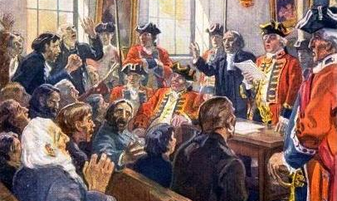
US immigration law creates hundreds of mini-dictators, empowered to enforce racist policy without question

Donald Dobkin is a Canadian-American immigration lawyer who, a few years back, authored a Georgetown Immigration Law Journal article titled Challenging the Doctrine of Consular Nonreviewability in Immigration Cases. The whole article is worth reading, but the short story is:

  • US consular officers are entitled to deny you a non-immigrant visa if you cannot prove to them you won’t immigrate to the US
  • Because this is considered a question of fact, under US law, this decision cannot be questioned or overturned, not even by the Secretary of State or the President
  • Courts have held that under very limited circumstances, they can review non-factual issues that affected the visa application outcome
  • However, the end result is that for the vast majority of people refused a non-immigrant visa to the US, there is no appeal mechanism and no check on US consular officers’ power to disrupt or destroy foreigners’ lives

One interesting thing I learned is that the doctrine of consular nonreviewability (sometimes mockingly called consular absolutism; John Lennon supposedly once referred to US consular officers as “absolute monarchs”) has its roots in the 1889 case Chac Chan Ping v. United States (often simply called the Chinese Exclusion Case). This is the case which first held that the government has the right to do whatever it likes to foreigners trying to enter the US, for whatever reason. Consequent immigration law doctrine in the US has built on the foundation of the Chinese Exclusion Case, especially in the area of consular nonreviewability. As Dobkin quotes one scholar saying:

Reliance on the Chinese Exclusion Case is a bit like reliance on Dred Scott v. Sandford or Plessy v. Ferguson. Although the Supreme Court has never expressly overruled the Chinese Exclusion Case, it represents a discredited page in the country’s constitutional history.

(For non-Americans, Dred Scott and Plessy v. Ferguson are two famous US Supreme Court cases which respectively held that black people have no rights and that racial segregation is constitutional.)

Immigration law’s roots in racism go deep. Beyond the US, virtually every modern Western country rooted in the common law tradition originally adopted immigration controls in order to exclude foreigners from the wrong racial backgrounds. See for instance the UK closing its borders to Commonwealth citizens because they received too many black and Asian immigrants, Australia adopting a “White Australia” legal regime to keep out Asian immigrants, or Canada pursuing immigration controls in the 19th century to restrict Chinese immigration.

And the best traditions of immigration law continue today. In Olsen v. Albright, former US consular officer Robert Olsen sued the State Department for wrongful dismissal after he refused to enforce a visa policy that discriminated against people who “look poor” or were born into the wrong race.  Given how well-documented the racist nature of State’s visa policy was, the judge had no choice but to agree with Olsen — but given the doctrine of consular nonreviewability, he had no power to overturn the denial of visas to anyone who, as one visa refusal documented, “Looks + talks poor.”

Dobkin notes that in many European countries, including Germany, judicial review of visa decisions is enshrined in law. The catastrophic effects which US judges and consular officers fear from permitting judicial review have not materialised. Dobkin suggests that this is because:

  1. Pursuing judicial review is costly, so applicants will only pursue it if they strongly believe the consular officer was wrong
  2. More importantly, the risk of facing judicial review forces consular officers to get visa decisions right

One interesting point Dobkin highlights is that unfortunately for foreigners, immigration law cases tend to be decided precisely when anti-immigrant sentiment runs high: you get a lot more immigration lawsuits when immigration law enforcement is at its peak. This bias means that immigration legal precedents favourable to immigrants are relatively rare, and likely accounts for the long survival of the Chinese Exclusion Case.

There are of course rare instances where the courts do decide to review a consular officer’s decision, and Dobkin cites quite a few. These are worth a separate post, which I will publish in due time. But they do not materially change the picture: US immigration policy enthrones consular officers as dictators, capable of punishing people for reasons as trivial as wearing the wrong coat or being from the wrong ethnic origin. Not even the President or Supreme Court can overturn their decision. And there is no real reason for this, except for the US immigration legal system’s peculiar attachment to consular nonreviewability, a doctrine rooted in racism, and one that plenty of other developed countries are fine doing without.

The painting featured at the top of this post depicts the deportation of Acadians from Canada in 1755.

Paul Kersey on immigration and multiethnic societies

Paul Kersey has a thought-provoking piece up at VDARE with some speculation about the potential consequences of expanded migration and/or legalization initiatives currently being mooted by US legislators and policy wonks. Kersey uses an interesting technique similar to something that has often cropped up in the posts and comments at this site (including, specifically, comments by BK): an analysis of the performance of multiethnic societies to inform the debate about the short-run and long-run consequences of open borders. While Kersey’s rhetorical style is perhaps more upfront and forthright than that employed by the typical sophisticated restrictionist, the style of argument he makes does appeal to a wide range of people.

Let me begin by noting what I like about Kersey’s approach. It seems to me that too often, discussions about the effects of policies are built on exceptionalist rhetoric that fails to learn from the experiences of other countries. For instance, discussions of affirmative action in one country often fail to consider evidence about affirmative action and similar policies employed in other countries. The same applies to discussions of the effects of the minimum wage, or of tax increases, or of conscription. The problem with ignoring other countries is that a single country usually doesn’t offer enough variation in its history to provide a lot of insight. Comparing across countries can help overcome this problem. There are a lot of caveats to be considered when doing inter-country comparisons, but it’s a tool that should be given a shot. This kind of analysis, incidentally, is one of the things that I admire Thomas Sowell for, even though I don’t often see eye to eye with Sowell’s moral outlook, empirical assertions, and rhetorical style (see here for my discussion of Sowell on migration and here for my personal views on Sowell’s output as a whole).

In addition to using an international perspective, it may also be important to extend the analysis beyond migration to other situations that might mimic the effects of migration. A common and plausible strand of thinking is that the performance of multiethnic societies compared to more homogeneous societies provides some insight into the effects open borders might have, in so far as open borders would make certain societies (the target countries of migration) more multiethnic. The use of these indirect proxies, weak and questionable though they may be from some perspectives, is better than just throwing up one’s hands or refusing to consider the question. Open borders is a radical proposal, and it behooves those discussing it to try their hardest to look at all the various things that could go right and wrong with open borders.

Based on the above, I was initially quite sympathetic to Paul Kersey’s attempt to figure out the impact of open borders by looking at two examples of racially and ethnically diverse societies that have been known to be ridden with conflict and problems — South Africa and Brazil. Clearly, my bottom line differs from Kersey’s, but I was hoping to gain some insight from Kersey’s piece on the matter. I was somewhat disappointed in this respect.

Kersey’s analysis of South Africa is similar to many other restrictionist analyses — South Africa ended apartheid, and look how bad things are in South Africa today. What does the evidence actually suggest? Grieve Chelwa did an excellent post on South Africa in the open borders debate. A very brief summary of his post: things were pretty bad and in many ways getting worse in the period 1980-1994 (prior to the end of apartheid), and things have generally been improving 1994-2008, though not very fast. But the improvement post-1994 is certainly quite impressive compared to the 1980-1994 performance. Within the 1994-2008 period, things have generally been better in the latter half of the period, and the poor performance in the beginning can be attributed to some bad leadership and statist economic policy. Grieve looks at poverty, inequality, unemployment, and crime. In the comments, BK brought up the decline in life expectancy, which is certainly one worrisome negative trend, and is mostly attributed to the HIV denialism of Thabo Mbeki. Clearly, there are no easy answers here, and South Africa is at best modestly encouraging and at worst modestly discouraging in terms of the case for open borders. With this background in mind, I thought Kersey might have some interesting insights to offer on the negative side of the ledger.

Kersey’s analysis of South Africa, however, involves block quoting the entirety of a sidebar (!) from a Daily Mail article about a rich guy shooting his girlfriend (it’s unclear whether the shooting was intentional or accidental). The sidebar laments South Africa’s high crime rate, and this is the main piece of evidence used by Kersey to conclude that apartheid was a failure. But as Grieve’s analysis showed, the rates for most violent crimes (including homicides, which have the most reliable data in general) has declined considerably since the end of apartheid, with the main exception to the trend being armed robberies (a quick-and-dirty version of the homicide data can be viewed here, but see the links in Grieve’s post for more). Probably, there are many interpretations of the statistics, but I’d have hoped that Kersey would not use a single-point-in-time number to draw conclusions about trends in post-apartheid South Africa.

I don’t really know enough (or in fact anything) about Brazil. Kersey’s analysis of Brazil looks potentially interesting, but I’d be loath to use it as an information source for reasons very similar to those that I elucidated for South Africa. I would strongly urge restrictionists like Kersey to perform deeper analyses of trends so that people on all sides of the debate have a better idea of the restrictionist end in the range of plausible conclusions one can draw from the data. By taking shortcuts and preferring sensation over substance, Kersey does both his own cause and the cause of truth a disservice.

Stan Tsirulnikov on progressive immigration restrictionism

Writing at The Umlaut, Stan Tsirulnikov offers an interesting take on progressive immigration restrictionism. Tsirulnikov dubs it “immigration protectionism” and critiques it as being against the spirit of the bold changes that progressivism should be about. The targets for Tsirulnikov’s criticism include Dean Baker, head of the progressive Center for Economic and Policy Research, for espousing strict limits on high-skilled immigration and apparently zero (?) low-skilled immigration. Another target is a piece by Josh Harkinson in Mother Jones titled How H-1B Visas Are Screwing Tech Workers. Tsirulnikov concludes:

Harkinson isn’t wrong to be concerned about the plight of struggling Americans. But as Bryan Caplan has pointed out in the past, it is morally questionable to put more emphasis on the “American” rather than the “struggling” part. Nevertheless, many progressives want to use immigration restrictions as a round-about way of helping vulnerable American workers. They know that the American public will not support direct subsidies to individual workers harmed by immigration, so they use restrictions as a cynical half-measure to prevent the supposed harm from happening at all. Baker’s proposal has the restrictions fall disproportionally on unskilled and poor foreigners, while Harkinson wants to make hiring high-skilled foreigners more difficult. But both view immigration as a potentially hostile force that needs to be managed for the exclusive benefit of Americans.

Overall, I tend to agree with Tsirulnikov. I considered progressive immigration restrictionism and its territorialist underpinnings in a blog post a little over two months ago (see also a ollow-up by Arnold Kling). I’ve also tried to address specific concerns raised by employees of the Economic Policy Institute (referenced by Harkinson’s Mother Jones piece) in the following blog posts: guest worker programs and worker abuses and Eisenbrey argues against increasing US visas for high-skilled work. Alex Nowrasteh offered a more detailed and forceful critique of Eisenbrey here.

Open borders: the right political and ethical choice for Republicans

Following up on my earlier discussion of why I think the US Republican Party would be wise to consider a more liberal approach to immigration, I note that the Republican Party of Nevada recently became the first state Republican party to endorse “amnesty” for unauthorised immigrants. Remarkably, their statement places a pathway to US citizenship on equal footing with “free enterprise” and “state responsibilities and local control” as priorities for the party. The relevant portion (emphasis in original):

The GOP has increasingly found itself in positions that do not meet the demographic realities of the State’s electorate. These positions also conflict with our party’s historic commitment to civil rights. To that end, Republicans must become more inclusive, reflecting our desire to secure a better life for all Americans, and equally important, for our children.

The United States should secure its borders, enforce the laws that exist, and recognize the many groups that have worked hard to support their families and build a community. These groups include Hispanics and other immigrant minorities, young and old, black and white. We support a pathway to citizenship for undocumented immigrants that would require registering with the government; and, include the ability to communicate in English, performing military or other community service, and proof of financial responsibility as required by the USCIS. One hundred and fifty years ago, our country fought a bloody Civil War. That war affirmed we have only one class of citizens— American.

It’s remarkably aggressive to compare the struggle for immigrant rights to the struggle against slavery in the US, and for this I say good on the Nevada GOP. But let’s put aside the moral dimension for now: even from a purely cold-blooded standpoint, it’s not at all unreasonable to believe that a more open stance towards immigration would be beneficial to the GOP.

Let’s take the preferences of different ethnic communities, which I previously discussed. Asians look to be a probable swing group, with some subgroups that historically have leaned Republican (e.g. non-African Muslims). Hispanics definitely lean Democratic, but with some fairly large gyrations in degree (George W. Bush narrowed historically very sizeable gaps in Hispanic support to about 20 percentage points).

Now if more Hispanics were to enter the US electorate today, that would be a huge concern for Republican strategists. It would be difficult for them to endorse outright citizenship for a very broad, undifferentiated swathe of unauthorised immigrants today. But that isn’t the only option they have. Republicans could just as well do what the Nevada GOP is doing and say: Sure, these people who live and work alongside Americans have just as much a right to aspire to citizenship as anyone else. But first, they should make reasonable amends for their past; if they do not, they must wait a substantial amount of time before becoming eligible to apply for citizenship.

Applying a filter of this sort would minimise the immediate hit to Republicans’ “bottom line”, so to speak. Moreover, if they position themselves correctly, and can claim the mantle of being the ones who saved immigration reform, doing this is liable to swing some portion of the current Hispanic electorate — not to mention other immigrant communities and other Americans who support reform. If we are doing a simple cost-benefit analysis, there is some potential long-run cost to this “amnesty”, but there is also a decent upfront benefit, one that might make this trade-off worth taking. It’s basic business practice to discount long-run costs/benefits and focus more on the upfront numbers, but I have not seen anyone actually try to run this basic cost-benefit analysis.

And we’re not even done yet. The preferences of communities can swing substantially based on the turn of events. Some surveys suggest the Muslim electorate swung from 70% for George W. Bush in his first term to 4% for Mitt Romney in 2012. Muslims were solidly Republican — right until they weren’t. If the Republicans can stake an even more aggressive position on immigration reform than Democrats and steal their thunder, there’s clearly a non-zero chance this will redound in a Hispanic swing substantial enough to turn their community from solidly Democratic to swing-voting or even leaning-Republican.

Moreover, Republicans need not and should not stop at a path to citizenship for unauthorised immigrants. They have a chance to shore up their brand as the party of “free enterprise” and “state responsibilities and local control”: immigration lawyer Angelo Paparelli has laid out over a dozen piecemeal immigration reforms that are consistent with core Republican principles and also build their brand as a forward-thinking party on immigration and social issues.

And there’s one other piece that Paparelli doesn’t have: Republicans should fight to open the borders, not just to more Hispanic immigrants, but to immigrants of all creeds and colours. The Latin American is but one of many who would like to call the US home. Again, Republicans can beat the Democrats at their own game: it’s not fair to the millions of poor in the world who work hard and have the same dreams as Americans to keep them out. Opening the gates to primarily more Hispanic immigrants is wonderful, but it perpetuates discrimination against someone born in Londonderry, Lahore, or Lagos.

If they pull this reorientation off, Republicans will have been responsible for one of the greatest expansions of liberty in the history of the world. Arbitrary immigration controls keep people in chains, prevent them from authoring their own life stories. The millions of new Americans and their descendants who get the vote (if the Republican-backed reforms will permit it) will forever owe a debt of gratitude to the farsighted Republican leaders who cynically chose to open the borders, knowing this would one day redound to them at the polls. (I jest, but only slightly — a hardheaded cost-benefit analysis was the starting point for this post after all.)

This whole scenario I’ve laid out seems incredible, if not impossible. I doubt it will happen. But the odds of it happening are definitely greater now than they were on the 5th of November 2012. Yes, the rudimentary beginnings of a cost-benefit analysis which I’ve laid out do not present a slam dunk for immigration reform. But neither is it a slam-dunk that immigration reform would be politically costly to the Republican Party, today or even tomorrow, despite this being restrictionist conventional wisdom.

And beyond the cost-benefit analysis, there is always a moral dimension. We cannot ignore forever the damage that morally-compromised laws do to immigrants, whether they live in our midst, or live faraway yearning to come. The Republican Party recognised this in 1864, when it proclaimed in its election manifesto:

Resolved, That foreign immigration, which in the past has added so much to the wealth, development of resources and increase of power to the nation, the asylum of the oppressed of all nations, should be fostered and encouraged by a liberal and just policy.

The Nevada GOP harked back to this when it recalled the waging of the US Civil War to prove “we have only one class of citizens”. But they would do well too to remember the words of Abraham Lincoln on the eve of that war:

As a nation, we began by declaring that “all men are created equal.” We now practically read it “all men are created equal, except negroes.” When the Know-Nothings get control, it will read “all men are created equal, except negroes, and foreigners, and catholics.” When it comes to this I should prefer emigrating to some country where they make no pretence of loving liberty — to Russia, for instance, where despotism can be take pure, and without the base alloy of hypocracy [sic].

Abraham Lincoln dedicated his life to the proposition that all men are created equal — black or white, foreigner or native. Lincoln himself told us: he would rather emigrate to Russia than put up with a modern Republicanism declaring that foreigners deserve unequal and unjust treatment. The defeat Republicans suffered at the polls in 2012 offers them a chance to redeem themselves, to stand proud once more as the party of Lincoln. The question is, will they take it?