Weekly link roundup 10

Here’s our weekly installment of links from around the web (see here for all link roundups). As usual, linking does not imply endorsement.

Open borders would abolish Bangladeshi sweatshops

Substandard working conditions recently murdered over 1,000 people in the deadliest garment factory accident in history. This accident in Bangladesh drew attention to the substandard wages of “sweatshop” workers in the developing world, and industrialists’ scant regard for their workers’ safety. Many on the left in the developed world saw this as an indictment of free market economics, urging government action to prevent such future disasters. Responding to such pressures, the US government recently raised tariffs on a number of Bangladeshi goods. I’m as concerned as anyone that Bangladeshi workers aren’t earning a fair wage or working in dangerous conditions. So it strikes me as strange that utterly absent from this debate has been the one measure that we know for sure would alleviate these conditions for countless Bangladeshis.

If we truly find it disgusting that Bangladeshis aren’t earning a fair wage for their work, or are being forced to work under slave-like conditions, we should ask ourselves: who is trapping Bangladeshis in their antiquated, inefficient economy? Do Bangladeshis really want to risk death every day to earn a pittance?

The standard analysis of this problem points out that the alternative to most Bangladeshis employed in industry is a life of subsistence agriculture. Farmers run the perennial risk of crop failure, and in the developing world, most subsistence farmers literally live hand to mouth, doing backbreaking labour in the sun. Industrial work may be risky, but it’s often a better alternative.

In response, you can argue that if people have to choose between a life of subsistence agriculture versus risking their lives for a job paying 50 cents an hour, this only illuminates the utter rottenness of the choices open to people in the developing world. And you’d be right. But it’s odd that we stop ourselves there. Sweatshops have been debated time and time again for decades, and yet hardly anyone seems to have stopped and asked themselves why these are the only two real choices open to sweatshop workers of the world. What’s keeping the Bangladeshi in the factory from doing the same work at a better wage elsewhere?

The answer, quite simply, is us. By politically and morally legitimising laws that ban Bangladeshis at gunpoint from working in our countries, we have left them no choice but to toil away in sweatshops. If we allowed them to cross borders in search of work, how many of them do you think would embrace the abominable wages and working conditions they’re forced to endure right now? Hundreds of thousands of Afghans literally risk being shot to death today so they can find work in Iran — if we allowed people to search for work across borders, without fear of abuse and murder, how much longer could sweatshops endure?

Part of the reason compensation in Bangladesh is lower than it is elsewhere is simply because of the differences in its economy versus the economies of developed countries: skill and human capital levels are different, the cost of living is different. But a major reason Bangladeshis are so underpaid is because we, the citizens of more developed countries, ban Bangladeshis from earning higher wages. The economic concept of the place premium illustrates this quite well: statistical analysis allows us to take an identical person and predict how their wages for doing the same work would vary depending on which country they work in.

When you consider the place premium, the magnitude by which people in the developed world are underpaid for their work is astonishing. People in the West get upset by wage discrimination on the basis of gender; without adjusting for statistical differences, women might underearn men by almost 30%. The magnitude of wage discrimination on the basis of nationality is so shocking, I cannot find any term to describe it that would be less apt than global apartheid.

For the exact same work that their American counterparts do, Bangladeshis are underpaid by almost 5 times — in other words, they are underpaid by almost 80%. And they aren’t even the worse victims of global apartheid — Yemenis and Nigerians are underpaid 15 times over compared to Americans. If Americans had allowed those dead Bangladeshi workers to work in the US, doing exactly the same work they were doing, not only would they be alive today, but they would be earning 5 times as much.

It is morally unconscionable that our conversations about sweatshops ignore the elephant in the room: we are the ones who put those sweatshop workers to death. It wasn’t just that we bought the goods those workers produced. It was that we banned those workers from working for us in our countries. We forced them to stay in Bangladesh, despite knowing that this would guarantee them an unfair wage and unsafe working conditions. We made them slaves to those sweatshops because they had no other choice — we took all their other choices away from them.

Until labour mobility and freedom of movement become part of the conversation about our economic rights and responsibilities, we might as well not be having any conversation at all. To ignore our immense fault for these people’s plight is morally callous and unjustifiable. In concluding his seminal 1997 essay on sweatshops, Paul Krugman wrote:

You may say that the wretched of the earth should not be forced to serve as hewers of wood, drawers of water, and sewers of sneakers for the affluent. But what is the alternative? Should they be helped with foreign aid? Maybe–although the historical record of regions like southern Italy suggests that such aid has a tendency to promote perpetual dependence. Anyway, there isn’t the slightest prospect of significant aid materializing. Should their own governments provide more social justice? Of course–but they won’t, or at least not because we tell them to. And as long as you have no realistic alternative to industrialization based on low wages, to oppose it means that you are willing to deny desperately poor people the best chance they have of progress for the sake of what amounts to an aesthetic standard–that is, the fact that you don’t like the idea of workers being paid a pittance to supply rich Westerners with fashion items.

In short, my correspondents are not entitled to their self-righteousness. They have not thought the matter through. And when the hopes of hundreds of millions are at stake, thinking things through is not just good intellectual practice. It is a moral duty.

That is a perfect summation of the case for doing business with sweatshops — except for one thing. Krugman utterly ignored the possibility of allowing the wretched of the earth to serve as sewers of sneakers for the affluent outside their home country. Allowing people to work under alternative economic and legal regimes if they are born into unjust and insensible regimes only makes sense. What reason do we have to not consider this alternative that Krugman couldn’t even bother to list? Are we willing to deny desperately poor people the best chance they have of progress for the sake of an aesthetic standard — because, say, we don’t like the idea of guest worker programmes?

Our conversation today on sweatshops automatically takes open borders off the table. We automatically rule out the one thing that would automatically abolish sweatshops, and automatically give the people of the world a fair choice in determining where they work and on what terms. What reason do we have not to give this proposal serious consideration? It’s our guns and tanks that ban good, honest people from taking better-paying jobs — that ban people from working in safe factories where they won’t have to worry daily about the roof caving in or the machinery catching fire. We need a damn good reason not to consider revoking our ban on people seeking fair work at fair wages.

In our conversations today, I just don’t see those reasons. And so as Krugman says, I don’t see how anyone in this debate can be entitled to their self-righteousness. Anyone ignoring labour mobility, or the fault of the developed world in banning poor people from looking farther for work, has simply not thought matters through. They have not done their moral duty. If you won’t consider open borders as a solution to sweatshops, then don’t bother complaining about sweatshops at all. You’re clearly not interested in solving the problem.

How to Seal a Border

Perhaps the most famous and ambitious attempt to seal a border was the Berlin Wall, built in 1961 and dismantled in 1989. It formed part of the Inner German border. Only in Berlin was it a real wall, elsewhere a system of restricted zones, protective strips, barbed-wire fences, minefields, and spring-guns, patroled by the Border Troops of the GDR, which were 44,000 strong in 1989. Another 3,000 to 5,000 “voluntary helpers” assisted them in their role. In addition, the Staatssicherheit (State Security) secret police employed 91,000 or 1 in 180 citizens, the largest security apparatus in world history, with another 173,000 unofficial collaborators. Not all Staatssicherheit personnel worked on preventing “Republikflucht”(desertion from the republic), but one of their major tasks was to block attemps early on. And then you would also have to add some of the 80,000 regular police officers of the “Volkspolizei” (People’s Police) and their 177,500 volunteers who were also engaged in detecting potential refugees.

So how did it work out?

Let’s go back to before the Wall was built, way before it was built. In 1891, the classical liberal politician Eugen Richter published a short novel: “Sozialdemokratische Zukunftsbilder,” translated as “Socialist Pictures of the Future” and also available online. He took the then Marxist program of the Social Democratic Party as his starting-point and made predictions what would happen after a Socialist revolution. His conclusion: Germany would team with secret and regular police and people would leave the Socialist “paradise” in droves because of its economic decay and political oppression. In the novel the Socialist leadership first take it in stride because they think that it is only about a few bourgeois exploiters and dissatisfied artists. But then they realize that all kinds of people try to emigrate. Since the government cannot tolerate the loss of their labor force, they eventually man the borders and shoot the refugees. Not only in this regard did Eugen Richter’s prediction turn out to be amazingly accurate.

Now fast forward: After the end of World War II, Germany and its capital were divided into American, British, French, and Soviet occuption zones. There was vast destruction in all of them, and economic conditions were dismal throughout. However, the Soviet Union put pressure on their occupation zone to go Communist from the start. That prompted hundreds of thousands to leave for the West, 1.6 million from October 1945 to June 1946 alone. In 1949 the GDR was established which institutionalized the Communist regime. Not only growing oppression in the GDR pushed people to emigrate, but also the “Wirtschaftswunder” (economic miracle) in the West exerted increasing pull. So from 1949 on, between 125,000 and 280,000 people left the GDR each year, with a peak of 390,000 in 1953, or more than 2% of the population. Until 1961, this added up to 2.7 million or about 15% of the population.

The GDR reacted with a series of ever stricter measures. In January 1951, it issued an executive order that demanded emigrants hand in their passports before leaving for the West or else face jail of up to three months. A passport law in September 1954 held out a prison sentence of up to three years for leaving the GDR without permission. Already in May 1952 the GDR had started to make massive efforts to seal the Inner German border. However, alerted by these measures and after the suppressed uprising of 1953, even more people left, most of them now via West Berlin where control was harder to implement. In 1961 the government of the GDR was at the end of its tether and made the fateful decision to seal the border for real. The construction of the Berlin Wall began on August 13, 1961. Eugen Richter’s prediction had become reality after 70 years, and also that border guards would shoot on refugees. At least a few hundred and probably more than 1,000 would die until 1989.

What’s interesting is that however impressive the Inner German border was, even after August 1961 plenty of people were able to cross it. Certainly not as many as had before, so the GDR could achieve its goal of stabilizing the regime, yet far more than one might expect. Those who wanted to leave showed an inventiveness that could well match that of the GDR apparatus: tunnels were built, some escaped in self-made balloons, West Germans smuggled others out in the trunk of their cars, and sometimes brute force would do the job with improvised explosives or a truck ramming through the border fortifications.

However, the first choice was to use an easier route via countries that did not have as strict a border regime. In this way more than 43,000 managed to leave the “Paradise of the Workers and Peasants” in 1961. Of course, the GDR clamped down on such emigration by restricting travel abroad. In 1962 there were still 11,000 of them, though, and in 1963 more than 9,000. Putting in more effort, the GDR reduced this number to a low of only 1,768 in 1979 from where it started to rise again to more than 9,000 in 1988. From 1961 to 1988 it all added up to slightly less than 180,000 emigrants. When Hungary opened its borders with Austria in September 1989, 15,000 East Germans on vacation in the country took the opportunity with both hands and left for the West in the first three days alone, another 20,000 in the rest of the month. Two months later the Wall was history.

What’s even more amazing is how many managed to cross the Inner German border as so-called “Sperrbrecher” (blockade breakers). There were 8,500 in 1961, and still 5,800 in 1962. The numbers dropped, but it took the GDR until 1970 to push it below 1,000 a year surging again to 1,800 in 1973. A low of 160 was only reached in 1985 after which the number started to rise again. The total from 1961 to 1988 came to an impressive 40,000 people who found the border fortifications no hindrance to leave. The “success” of the GDR in reducing numbers came with ever heavier oppression. From January 1968 on, “illegal border crossings” led to a sentence of up to two years, or for “more serious cases” of up to five years which was increased to eight years in 1979. Also surveillance of the population grew ever tighter. From 1976 when the Staatssicherheit started to keep tabs to 1988 about 38,000 attempts to leave the GDR were thwarted or about 3,000 on average a year. However, border checks themselves proved rather inefficient despite the high level of scrutiny. Of the 3,000 “Ausschleusungen” (smuggling out) about 1,200 succeeded or roughly 40%.

What are some of the conclusions that closed border enthusiasts can draw from the experience of the Inner German border and the Berlin Wall?

Well, first a moral point that I would make: all this was a grave injustice, barring millions of people from escaping oppression and improving their economic condition. I am glad the Federal Republic of Germany never for a moment thought about sending anyone back. Actually the Federal Republic even bought out many of those who had been caught or were imprisoned for just handing in an application to leave the GDR. And I am also glad the Federal Republic of Germany restricted this not only to Germans from the East under the assumption that the GDR was illegitimate and so refugees were German citizens. Also Hungarians after the failed revolution of 1956, Czechs and Slovaks in 1968, Vietnamese boat people in the 1970s and Poles in the 1980s were welcomed and not sent back.

The other conclusion is that you cannot seal a border completely. The GDR even had the advantage that it had a Socialist economic system where all economic activity across the border is under state control and hence monitored more easily. Likewise the GDR did not have to care much about business travelers or tourists. And then it still took a lot a effort. A quarter of a percent of the GDR population were engaged in border control. Another percent worked on surveilling the populace for the Staatssicherheit and Volkspolizei, more than one percent acted in a supporting role. And, of course, it all involved a lot of intrusion and disregard for civil liberties. The only good point I can see was that throttling exchange with the outside world also made the GDR so much poorer and backward that it could not accomplish all it wanted. Some former Staatsicherheit officers have recently expressed awe at the extent of NSA data collection. However, if so often any potentially negative consequences of free migration are highlighted, how about the concrete negative consequences of trying to block it? If you want to literally seal a border, it takes more effort than even the GDR put into it.

Additional Remarks

– There is a difference between keeping people in and out of a country. Being locked in in the GDR was much more serious than being locked out. However, thwarting emigration is at the same time much easier because the government has all the means to surveil the population, build a dense network of informers, etc. In the analogous case for immigration, this would amount to doing all this on foreign soil.

– My numbers come from different sources, so they are not perfectly consistent. According to the Staatssicherheit data, there were fewer people who escaped. Since my point does not depend on the exact numbers, but only on the order of magnitude, I have not tried to mend this. My point is that hundreds and maybe thousands could cross the Inner German border each year even against the coordinated and massive efforts of a huge police apparatus.

– One of Eugen Richter’s predictions was also that the Socialist state would have no problem with emigration of pensioners. Actually, that turned out to be true as well. The GDR dumped old people on the Federal Republic of Germany. This is a caveat for proponents of open borders who argue that a welfare state and free migration do not collide or only in a minor way. That may be true under current conditions where immigration policies are tilted towards young people. Cynical governments like the GDR could well put this to the test.

– I am sorry that many of the references point to websites in German. Unfortunately often I could not find similar material in English. I hope with some translation tool you can get a grasp of what is in the German original.

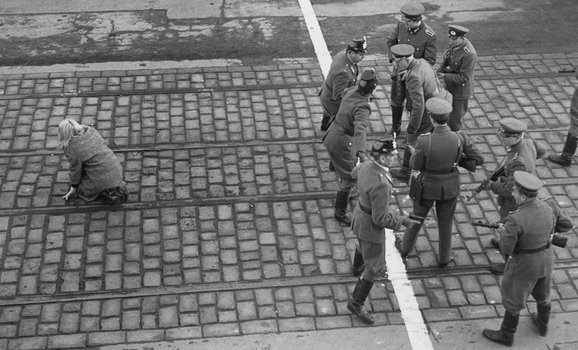
The photograph featured at the top of this post is of West and East German border police confronting each other, moments after a woman successfully crossed the interior German border in Berlin, 1955. Photo by Three Lions/Hulton Archive/Getty Images, via the Google Cultural Institute.

Weekly link roundup 9

Here’s our weekly installment of links from around the web (see here for all link roundups). As usual, linking does not imply endorsement.

Immigration restrictions are a threat to liberty everywhere

In the civil libertarian world today, two issues rule the roost: surveillance and drones. Ordinarily civil rights issues like these find it difficult to gain traction, but increasingly it looks like even the mainstream media can’t ignore these issues. Spying on the behaviour of millions of innocent people, and murdering innocent people (AKA “collateral damage”) from a remote-controlled airplane, are difficult things to readily reconcile with modern ideas of human rights and freedoms. These issues make me think: how long before civil libertarians begin to comprehend the danger of similar totalitarian disregard for liberty in immigration policy?

Drones are primarily a concern for people burdened by the welfare of innocent people in war zones. Innocents in Yemen, Afghanistan, and Pakistan live daily in fear of an errant missile strike, meant for another, but still deadly to all innocents in its path. The policy for deploying drones, and launching their weaponry, until recently has been near-entirely opaque (some would argue it is still entirely opaque). What due process do we have to ensure that drones won’t recklessly murder dozens, hundreds, of guiltless people, in search of taking out one terrorist? What assurances can we give innocents that an overzealous government bureaucrat can’t use his discretion to murder innocent human beings?

The rationale for the US government’s National Security Agency surveillance programmes has always been: we spy on foreigners’ data, not our own. The NSA still maintains it protects US citizens’ data rigorously, though there are many reasonable doubts that this is true. Edward Snowden’s revelations, even if reconciled with the NSA’s claims about protecting US nationals’ data, still ring alarm bells for American civil libertarians: how easy might it be for the NSA to turn the same lens it has trained on foreigners onto us instead? In 1975, US Senator Frank Church warned of such surveillance:

That capability at any time could be turned around on the American people and no American would have any privacy left, such [is] the capability to monitor everything: telephone conversations, telegrams, it doesn’t matter. There would be no place to hide. If this government ever became a tyranny, if a dictator ever took charge in this country, the technological capacity that the intelligence community has given the government could enable it to impose total tyranny, and there would be no way to fight back, because the most careful effort to combine together in resistance to the government, no matter how privately it was done, is within the reach of the government to know.

Since I blog for Open Borders, you would be wise to surmise that neither drones nor NSA surveillance are issues I think about much. But like millions of others, these are issues that weigh on me nonetheless. It worries me that innocent people are subject to murder by the state without due process. It worries me that innocent people are subject to surveillance by the state, again, without due process. And I know these worries all too well, for as an immigrant and someone who enjoys reading stories of immigration, I have seen just how utterly the modern state throws due process in the garbage the moment an immigrant crosses the threshold.

I’ve written before about how perplexed I am that civil libertarians devote a disproportionate amount of energy to criticising allegedly dehumanising air travel procedures. I’m glad to see that deserving due process issues are taking up more attention than ever before. But civil libertarians need to add another issue to complete their trifecta of due process concerns: drone murder, arbitrary surveillance, and arbitrary restriction of human movement. The simplicity and fairness of open borders is not just a nice-to-have; it is critical for a just and fair legal process.

I and others have written time and time again about how modern immigration procedures recklessly abandon due process. Ask yourself: did the refugees whose files were wheeled past a UK Minister so civil servants could “truthfully” tell Parliament that a Minister had duly reviewed their applications get justice? Did they get due process? How about the Brazilians whose visa applications were rejected because a US consulate decided that black visa applicants must be poor? Did they get due process?

Any US consular officer is entitled to reject most visa applications for any reason they like. This “consular nonreviewability” discretion, by US law, cannot be challenged in court or overruled by senior officials — not even the President. Since 1990, the American Bar Association has persistently asked the US government every year to  “establish increased due process in consular visa adjudications and a system for administrative review of certain visa denials, including specified principles” — a request that has consistently fallen on deaf ears. In 2005, the US State Department issued a report recommending further reductions in existing due process and more discretion for consular officials.

It would be one thing if this due process brouhaha focused on police officers arbitrarily writing speeding tickets (as they often seem to be doing in many jurisdictions). But this lack of due process tears families apart. It destroys jobs. Imagine if you lost your job because your employer claimed you were a drug smuggler (based on your name resembling someone else’s, who actually is a drug smuggler) — and you had no right to challenge that claim in court. That actually happened to one unlucky immigrant in the US. A lack of legal due process harms real human beings; it breaks hearts and homes.

It is no consolation that the government is only empowered to take your spouse and children away from you, or fire you from your job, if you’re a foreigner. As Senator Church warned in 1975:

I don’t want to see this country ever go across the bridge. I know the capacity that is there to make tyranny total in America, and we must see to it that this agency and all agencies that possess this technology operate within the law and under proper supervision, so that we never cross over that abyss. That is the abyss from which there is no return. (emphasis added)

A government powerful enough to arbitrarily evict your neighbour from his home, take him away from his family, and take his livelihood away from him, is powerful enough to do that to you too. One remarkable thing I’ve found about the debate surrounding drones and surveillance is that the people criticising them often also implicitly criticise a focus solely on the well-being of citizens, urging us to account for these policies in the totality of their effects on innocent human beings, regardless of nationality. I do not think this criticism of citizenism has struck that much of a chord with the masses — Glenn Greenwald may worry about the innocent Afghan victims of drones, or innocent British victims of surveillance, but the median news media consumer probably does not.

However, these issues resonate, because people appreciate the risk of giving government too much power — the power to kill and the power to spy without the process of law or supervision. Perhaps people need a similar awakening about the power of government to keep you alive while taking away everything you hold dear — your home, your job, your family. That the victims are mere foreigners should be little consolation. A government powerful enough to do anything without due process is powerful enough to make a victim of you too.

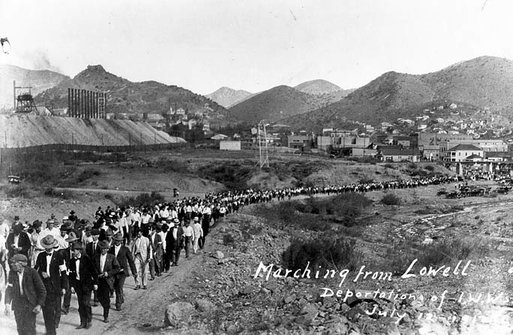
The photograph featured at the top of this post is of striking miners being deported from Bisbee, Arizona in 1917. Scanned by the Arizona Historical Society; original photographer unknown.